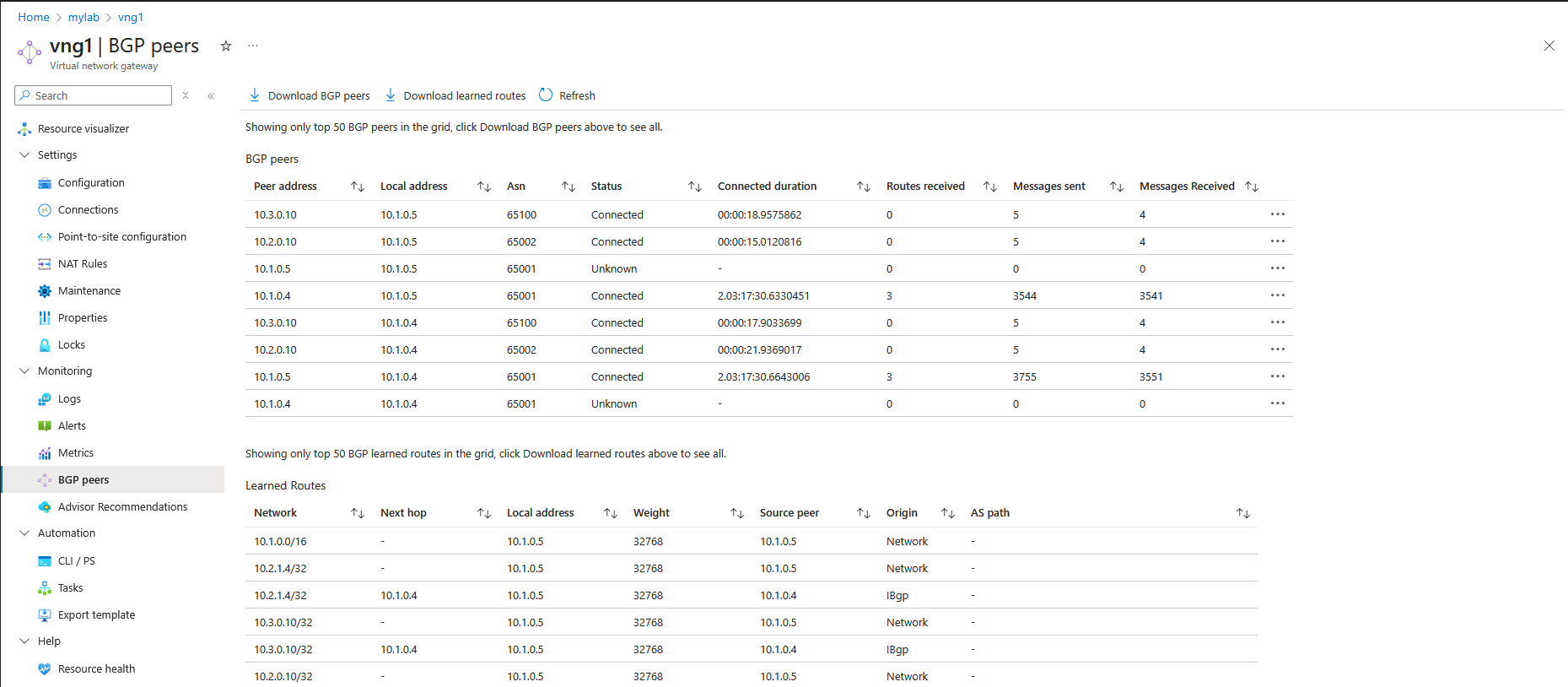
Estuve mirando el otro día el what the hack 36 y voy a poner un poco paso a paso lo que tuve que hacer
El código está sacado del hack 36 pero yo lo dividí en pequeñas partes. Los comandos se ejecutan en el bash de Azure
Defino las variables para tenerlas a mano
#!/bin/bash
## Define "Global" script variables
nva_publisher=cisco
nva_offer=cisco-c8000v-byol
nva_sku=17_15_01a-byol

default_username=labadmin

test_vm_image_urn=Ubuntu2404

routers=("1:vng:65501" "2:csr:65502")
connections=("1:2")
rg=bgp
location=westeurope
psk=Microsoft123!

function accept_csr_terms () {
    #USES NVA GLOBALS
    nva_version=$(az vm image list -p $nva_publisher -f $nva_offer -s $nva_sku --all --query '[0].version' -o tsv)
    if [[ -z "$nva_version" ]]
    then
        echo "Could not locate an image version for ${nva_publisher}:${nva_offer}:${nva_sku}, double-check Publisher, offer, and SKU"
        exit 1
    fi
    # Accept terms
    echo "Accepting image terms for ${nva_publisher}:${nva_offer}:${nva_sku}:${nva_version}..."
    az vm image terms accept --urn "${nva_publisher}:${nva_offer}:${nva_sku}:${nva_version}" -o none
    # Verify
    status=$(az vm image terms show --urn "${nva_publisher}:${nva_offer}:${nva_sku}:${nva_version}" --query accepted -o tsv)
    if [[ "$status" != "true" ]]
    then
        echo "Marketplace image terms for ${nva_publisher}:${nva_offer}:${nva_sku}:${nva_version} could not be accepted, do you have access at the subscription level?"
        exit 1
    fi
}

accept_csr_terms
echo "- $nva_version -"
Compruebo los prerequisitos
#!/bin/bash
## Define "Global" script variables
nva_publisher=cisco
nva_offer=cisco-c8000v-byol
nva_sku=17_15_01a-byol

# Variables
default_username=labadmin

# Define Test VM linux image
test_vm_image_urn=Ubuntu2404
function perform_system_checks () {
    # Verify software dependencies
    for binary in "ssh" "jq" "az" "awk"
    do
        binary_path=$(which "$binary")
        if [[ -z "$binary_path" ]]
        then
            echo "It seems that $binary is not installed in the system. Please install it before trying this script again"
            exit
        fi
    done
    echo "All dependencies checked successfully"

    # Verify az is logged in
    subscription_name=$(az account show --query name -o tsv)
    if [[ -z "$subscription_name" ]]
    then
        echo "It seems you are not logged into Azure with the Azure CLI. Please use \"az login\" before trying this script again"
        exit
    fi

    # Verify required az extensions installed
    for extension_name in "log-analytics"
    do
        az extension add --upgrade --yes --name $extension_name -o none
        extension_version=$(az extension show -n $extension_name --query version -o tsv)
        if [[ -z "$extension_version" ]]
        then
            echo "It seems that the Azure CLI extension \"$extension_name\" is not installed. Please install it with \"az extension add -n $extension_name\" before trying this script again"
            exit
        else
            echo "Azure CLI extension \"$extension_name\" found with version $extension_version"
        fi
    done
}
# Create lab variable from arguments, or use default
if [ -n "$BASH_VERSION" ]; then
    echo "Running on BASH"
elif [ -n "$ZSH_VERSION" ]; then
    echo "Running on ZSH"
fi
Creo el grupo de recursos con una configuración de un Virtual Network Gateway
#!/bin/bash
## Define "Global" script variables
nva_publisher=cisco
nva_offer=cisco-c8000v-byol
nva_sku=17_15_01a-byol

default_username=labadmin

test_vm_image_urn=Ubuntu2404

routers=("1:vng:65501" "2:csr:65502")
connections=("1:2")
rg=mylab
location=westeurope
psk=Microsoft123!

# Create resource group
echo "Creating resource group \"$rg\" in subscription \"$subscription_name\"..."
az group create -n "$rg" -l "$location" -o none
Creo los recursos
#!/bin/bash
## Define "Global" script variables
nva_publisher=cisco
nva_offer=cisco-c8000v-byol
nva_sku=17_15_01a-byol
#####
default_username=labadmin
test_vm_image_urn=Ubuntu2404
routers=("1:vng:65001" "2:csr:65002" "3:csr:65100")
connections=("1:2" "1:3")
rg=mylab
location=westeurope
psk=Microsoft123!
# Waits until a resource finishes provisioning
# Example: wait_until_finished <resource_id>
function wait_until_finished () {
wait_interval=60
resource_id=$1
resource_name=$(echo "$resource_id" | cut -d/ -f 9)
echo "Waiting for resource $resource_name to finish provisioning..."
start_time=$(date +%s)
state=$(az resource show --id "$resource_id" --query properties.provisioningState -o tsv 2>/dev/null)
until [[ "$state" == "Succeeded" ]] || [[ "$state" == "Failed" ]] || [[ -z "$state" ]]
do
sleep $wait_interval
state=$(az resource show --id "$resource_id" --query properties.provisioningState -o tsv 2>/dev/null)
done
if [[ -z "$state" ]]
then
echo "Something really bad happened..."
else
run_time=$(("$(date +%s)" - "$start_time"))
((minutes=run_time/60))
((seconds=run_time%60))
echo "Resource $resource_name provisioning state is $state, wait time $minutes minutes and $seconds seconds"
fi
}
# Remove special characters and empty lines from string
# Used in case the SSH session to IOS returns invalid characters (like CR aka 0x0d), but that doesnt seem to be the case,
# so left to remove empty strings for the time being
function clean_string () {
output=$1
# output=$(echo $output | tr '\r' '\n') # Replace \r with \n
output=$(echo "$output" | tr -d '\r') # Delete \r
# output=$(echo $output | tr -dc '[:alnum:]\ \.\,\n') # Remove special characters
output=$(echo "$output" | awk NF) # Remove empty lines
echo "$output"
}
# Wait until a public IP address answers via SSH
# The only thing CSR-specific is the command sent
function wait_until_csr_available () {
wait_interval=15
csr_id=$1
csr_ip=$(az network public-ip show -n "csr${csr_id}-pip" -g "$rg" --query ipAddress -o tsv)
echo "Waiting for CSR${csr_id} with IP address $csr_ip to answer over SSH..."
start_time=$(date +%s)
ssh_command="show version | include uptime" # 'show version' contains VM name and uptime
ssh_output=$(ssh -n -o ConnectTimeout=60 -o ServerAliveInterval=60 -o BatchMode=yes -o StrictHostKeyChecking=no -o KexAlgorithms=+diffie-hellman-group14-sha1 -o HostKeyAlgorithms=+ssh-rsa -o PubkeyAcceptedKeyTypes=+ssh-rsa -o MACs=+hmac-sha2-256-etm@openssh.com,hmac-sha2-512-etm@openssh.com "${default_username}@${csr_ip}" "$ssh_command" 2>/dev/null)
until [[ -n "$ssh_output" ]]
do
sleep $wait_interval
fix_all_nsgs # possible my NSGs are broken?
ssh_output=$(ssh -n -o ConnectTimeout=60 -o ServerAliveInterval=60 -o BatchMode=yes -o StrictHostKeyChecking=no -o KexAlgorithms=+diffie-hellman-group14-sha1 -o HostKeyAlgorithms=+ssh-rsa -o PubkeyAcceptedKeyTypes=+ssh-rsa -o MACs=+hmac-sha2-256-etm@openssh.com,hmac-sha2-512-etm@openssh.com "${default_username}@${csr_ip}" "$ssh_command" 2>/dev/null)
done
run_time=$(("$(date +%s)" - "$start_time"))
((minutes=run_time/60))
((seconds=run_time%60))
echo "IP address $csr_ip is available (wait time $minutes minutes and $seconds seconds). Answer to SSH command \"$ssh_command\": $(clean_string "$ssh_output")"
}
# Wait until all VNGs in the router list finish provisioning
function wait_for_csrs_finished () {
for router in "${routers[@]}"
do
type=$(get_router_type "$router")
id=$(get_router_id "$router")
if [[ "$type" == "csr" ]]
then
wait_until_csr_available "$id"
fi
done
}
# Add required rules to an NSG to allow traffic between the vnets (RFC1918)
function fix_nsg () {
nsg_name=$1
if [[ -z "$2" ]]
then
# Grab my client IP for SSH admin rule
myip=$(curl -s4 "https://api.ipify.org/")
declare -i i="0"
until [[ $myip =~ ^[0-9]+\.[0-9]+\.[0-9]+\.[0-9]+$ ]] || [[ $i -gt 5 ]]
do
sleep 5
myip=$(curl -s4 "https://api.ipify.org/")
((i++))
done
# I tried to get my IP many times. Maybe something bad happened?
if [[ $i -gt 5 ]]
then
echo "Something is wrong with retrieving my public IP from the remote API service at \"https://api.ipify.org/\". Response from service: $myip"
exit 1
fi
else
# Called by something else that already did the work for me
myip=$2
fi
#echo "Adding SSH permit for ${myip} to NSG ${nsg_name}..."
az network nsg rule create --nsg-name "$nsg_name" -g "$rg" -n ssh-inbound-allow --priority 1000 \
--source-address-prefixes "$myip" --destination-port-ranges 22 --access Allow --protocol Tcp \
--description "Allow ssh inbound" -o none
#echo "Adding RFC1918 prefixes to NSG ${nsg_name}..."
az network nsg rule create --nsg-name "$nsg_name" -g "$rg" -n Allow_Inbound_RFC1918 --priority 2000 \
--access Allow --protocol '*' --source-address-prefixes '10.0.0.0/8' '172.16.0.0/12' '192.168.0.0/16' --direction Inbound \
--destination-address-prefixes '10.0.0.0/8' '172.16.0.0/12' '192.168.0.0/16' --destination-port-ranges '*' -o none
az network nsg rule create --nsg-name "$nsg_name" -g "$rg" -n Allow_Outbound_RFC1918 --priority 2000 \
--access Allow --protocol '*' --source-address-prefixes '10.0.0.0/8' '172.16.0.0/12' '192.168.0.0/16' --direction Outbound \
--destination-address-prefixes '10.0.0.0/8' '172.16.0.0/12' '192.168.0.0/16' --destination-port-ranges '*' -o none
}
# Add permit rules to all nsgs in the RG
function fix_all_nsgs () {
nsg_list=$(az network nsg list -g "$rg" --query '[].name' -o tsv)
# Grab my client IP for SSH admin rule
myip=$(curl -s4 "https://api.ipify.org/")
declare -i i="0"
until [[ $myip =~ ^[0-9]+\.[0-9]+\.[0-9]+\.[0-9]+$ ]] || [[ $i -gt 5 ]]
do
sleep 5
myip=$(curl -s4 "https://api.ipify.org/")
((i++))
done
# I tried to get my IP many times. Maybe something bad happened?
if [[ $i -gt 5 ]]
then
echo "Something is wrong with retrieving my public IP from the remote API service at \"https://api.ipify.org/\". Response from service: $myip"
exit 1
fi
echo "$nsg_list" | while read nsg
do
fix_nsg "$nsg" "$myip"
done
}
# Creates BGP-enabled VNG
# ASN as parameter is optional
function create_vng () {
id=$1
asn=$2
if [[ -n "$2" ]]
then
asn=$2
else
asn=$(get_router_asn_from_id "${id}")
fi
vnet_name=vng${id}
vnet_prefix=10.${id}.0.0/16
subnet_prefix=10.${id}.0.0/24
test_vm_name=testvm${id}
test_vm_nsg_name="${test_vm_name}-NSG"
test_vm_nic_name="${test_vm_name}-nic"
test_vm_pip_name="${test_vm_name}-pip"
test_vm_size=Standard_B1s
test_vm_subnet_prefix=10.${id}.1.0/24
type=$(get_router_type_from_id "$id")
# Create vnet
echo "Creating vnet $vnet_name..."
az network vnet create -g "$rg" -n "$vnet_name" --address-prefix "$vnet_prefix" --subnet-name GatewaySubnet --subnet-prefix "$subnet_prefix" -o none
# Create test VM (to be able to see effective routes)
# Not possible to create a test VM while a gateway is Updating, therefore starting the VM creation before the gateway
test_vm_id=$(az vm show -n "$test_vm_name" -g "$rg" --query id -o tsv 2>/dev/null)
if [[ -z "$test_vm_id" ]]
then
echo "Creating test virtual machine $test_vm_name in vnet $vnet_name in new subnet $test_vm_subnet_prefix..."
az network nsg create -n "$test_vm_nsg_name" -g "$rg" -l "$location" -o none
fix_nsg "$test_vm_nsg_name"
az network vnet subnet create --vnet-name "$vnet_name" -g "$rg" -n testvm --address-prefixes "$test_vm_subnet_prefix" \
--nsg "$test_vm_nsg_name" -o none
az network public-ip create -n "$test_vm_pip_name" -g "$rg" -l "$location" --sku standard -o none
az network nic create -n "$test_vm_nic_name" -g "$rg" -l "$location" --vnet-name "$vnet_name" --subnet testvm \
--private-ip-address "10.${id}.1.4" --public-ip-address "$test_vm_pip_name" -o none
# Not using $psk as password because it might not fulfill the password requirements for Azure VMs
az vm create -n "$test_vm_name" -g "$rg" -l "$location" --image "$test_vm_image_urn" --size "$test_vm_size" \
--generate-ssh-keys --authentication-type all --admin-username "$default_username" --admin-password "$psk" \
--nics "$test_vm_nic_name" --no-wait -o none
else
echo "Virtual machine $test_vm_name already exists"
fi
# Create PIPs for gateway (this gives time as well for the test VM NICs to be created and attached to the subnet)
echo "Creating public IP addresses for gateway vng${id}..."
az network public-ip create -g "$rg" -n "vng${id}a" --sku standard -o none
az network public-ip create -g "$rg" -n "vng${id}b" --sku standard -o none
# Create VNG
vng_id=$(az network vnet-gateway show -n "vng${id}" -g "$rg" --query id -o tsv 2>/dev/null)
if [[ -z "${vng_id}" ]]
then
if [[ "$type" == "vng" ]] || [[ "$type" == "vng2" ]]
then
echo "Creating VNG vng${id} in active/active mode..."
az network vnet-gateway create -g "$rg" --sku VpnGw2 --vpn-gateway-generation Generation2 --gateway-type Vpn --vpn-type RouteBased \
--vnet "$vnet_name" -n "vng${id}" --asn "$asn" --public-ip-address "vng${id}a" "vng${id}b" --no-wait
elif [[ "$type" == "vng1" ]]
then
echo "Creating VNG vng${id} in active/passive mode..."
az network vnet-gateway create -g "$rg" --sku VpnGw2 --vpn-gateway-generation Generation2 --gateway-type Vpn --vpn-type RouteBased \
--vnet "$vnet_name" -n "vng${id}" --asn "$asn" --public-ip-address "vng${id}a" --no-wait
else
echo "Sorry, I do not understand the VNG type $type"
fi
else
echo "VNG vng${id} already exists"
fi
}
# Connect 2 VPN gateways to each other
function connect_gws () {
gw1_id=$1
gw2_id=$2
cx_type=$3
gw1_type=$(get_router_type_from_id "$gw1_id")
gw2_type=$(get_router_type_from_id "$gw2_id")
echo "Connecting vng${gw1_id} and vng${gw2_id}. Finding out information about the gateways..."
# Using Vnet-to-Vnet connections (no BGP supported)
# az network vpn-connection create -g $rg -n ${gw1_id}to${gw2_id} \
# --enable-bgp --shared-key $psk \
# --vnet-gateway1 vng${gw1_id} --vnet-gateway2 vng${gw2_id}
# Using local gws
# Create Local Gateways for vpngw1
vpngw1_name=vng${gw1_id}
vpngw1_bgp_json=$(az network vnet-gateway show -n "$vpngw1_name" -g "$rg" --query 'bgpSettings' -o json )
vpngw1_asn=$(echo "$vpngw1_bgp_json" | jq -r '.asn')
vpngw1_gw0_pip=$(echo "$vpngw1_bgp_json" | jq -r '.bgpPeeringAddresses[0].tunnelIpAddresses[0]')
vpngw1_gw0_bgp_ip=$(echo "$vpngw1_bgp_json" | jq -r '.bgpPeeringAddresses[0].defaultBgpIpAddresses[0]')
if [[ ${gw1_type} == "vng" ]] || [[ ${gw1_type} == "vng2" ]]
then
vpngw1_gw1_pip=$(echo "$vpngw1_bgp_json" | jq -r '.bgpPeeringAddresses[1].tunnelIpAddresses[0]')
vpngw1_gw1_bgp_ip=$(echo "$vpngw1_bgp_json" | jq -r '.bgpPeeringAddresses[1].defaultBgpIpAddresses[0]')
echo "Extracted info for vpngw1: ASN $vpngw1_asn, GW0 $vpngw1_gw0_pip, $vpngw1_gw0_bgp_ip. GW1 $vpngw1_gw1_pip, $vpngw1_gw1_bgp_ip."
elif [[ "$gw1_type" == "vng1" ]]
then
echo "Extracted info for vpngw1: ASN $vpngw1_asn, $vpngw1_gw0_pip, $vpngw1_gw0_bgp_ip."
else
echo "Sorry, I do not understand the VNG type $gw1_type"
fi
echo "Creating local network gateways for vng${gw1_id}..."
local_gw_id=$(az network local-gateway show -g "$rg" -n "${vpngw1_name}a" --query id -o tsv 2>/dev/null)
if [[ -z "$local_gw_id" ]]
then
az network local-gateway create -g "$rg" -n "${vpngw1_name}a" --gateway-ip-address "$vpngw1_gw0_pip" \
--local-address-prefixes "${vpngw1_gw0_bgp_ip}/32" --asn "$vpngw1_asn" --bgp-peering-address "$vpngw1_gw0_bgp_ip" --peer-weight 0 -o none
else
echo "Local gateway ${vpngw1_name}a already exists"
fi
# Create second local gateway only if the type is "vng" (default) or "vng2"
if [[ ${gw1_type} == "vng" ]] || [[ ${gw1_type} == "vng2" ]]
then
local_gw_id=$(az network local-gateway show -g "$rg" -n "${vpngw1_name}b" --query id -o tsv 2>/dev/null)
if [[ -z "$local_gw_id" ]]
then
az network local-gateway create -g "$rg" -n "${vpngw1_name}b" --gateway-ip-address "$vpngw1_gw1_pip" \
--local-address-prefixes "${vpngw1_gw1_bgp_ip}/32" --asn "$vpngw1_asn" --bgp-peering-address "$vpngw1_gw1_bgp_ip" --peer-weight 0 -o none
else
echo "Local gateway ${vpngw1_name}b already exists"
fi
fi
# Create Local Gateways for vpngw2
vpngw2_name=vng${gw2_id}
vpngw2_bgp_json=$(az network vnet-gateway show -n "$vpngw2_name" -g "$rg" -o json --query 'bgpSettings')
vpngw2_asn=$(echo "$vpngw2_bgp_json" | jq -r '.asn')
vpngw2_gw0_pip=$(echo "$vpngw2_bgp_json" | jq -r '.bgpPeeringAddresses[0].tunnelIpAddresses[0]')
vpngw2_gw0_bgp_ip=$(echo "$vpngw2_bgp_json" | jq -r '.bgpPeeringAddresses[0].defaultBgpIpAddresses[0]')
echo "Creating local network gateways for vng${gw2_id}..."
local_gw_id=$(az network local-gateway show -g "$rg" -n "${vpngw2_name}a" --query id -o tsv 2>/dev/null)
if [[ ${gw2_type} == "vng" ]] || [[ ${gw2_type} == "vng2" ]]
then
vpngw2_gw1_pip=$(echo "$vpngw2_bgp_json" | jq -r '.bgpPeeringAddresses[1].tunnelIpAddresses[0]')
vpngw2_gw1_bgp_ip=$(echo "$vpngw2_bgp_json" | jq -r '.bgpPeeringAddresses[1].defaultBgpIpAddresses[0]')
echo "Extracted info for vpngw2: ASN $vpngw2_asn GW0 $vpngw2_gw0_pip, $vpngw2_gw0_bgp_ip. GW1 $vpngw2_gw1_pip, $vpngw2_gw1_bgp_ip."
elif [[ "$gw2_type" == "vng1" ]]
then
echo "Extracted info for vpngw1: ASN $vpngw2_asn, $vpngw2_gw0_pip, $vpngw2_gw0_bgp_ip."
else
echo "Sorry, I do not understand the VNG type $gw2_type"
fi
if [[ -z "$local_gw_id" ]]
then
az network local-gateway create -g "$rg" -n "${vpngw2_name}a" --gateway-ip-address "$vpngw2_gw0_pip" \
--local-address-prefixes "${vpngw2_gw0_bgp_ip}/32" --asn "$vpngw2_asn" --bgp-peering-address "$vpngw2_gw0_bgp_ip" --peer-weight 0 -o none
else
echo "Local gateway ${vpngw2_name}a already exists"
fi
# Create second local gateway only if the type is "vng" (default) or "vng2"
if [[ ${gw2_type} == "vng" ]] || [[ ${gw2_type} == "vng2" ]]
then
local_gw_id=$(az network local-gateway show -g "$rg" -n "${vpngw2_name}b" --query id -o tsv 2>/dev/null)
if [[ -z "$local_gw_id" ]]
then
az network local-gateway create -g "$rg" -n "${vpngw2_name}b" --gateway-ip-address "$vpngw2_gw1_pip" \
--local-address-prefixes "${vpngw2_gw1_bgp_ip}/32" --asn "$vpngw2_asn" --bgp-peering-address "$vpngw2_gw1_bgp_ip" --peer-weight 0 -o none
else
echo "Local gateway ${vpngw2_name}b already exists"
fi
fi
# Create connections
echo "Connecting vng${gw1_id} to local gateways for vng${gw2_id}..."
if [[ "$cx_type" == "nobgp" ]]
then
bgp_option=""
else
bgp_option="--enable-bgp"
fi
# 1->2A
az network vpn-connection create -n "vng${gw1_id}tovng${gw2_id}a" -g "$rg" --vnet-gateway1 "vng${gw1_id}" \
--shared-key "$psk" --local-gateway2 "${vpngw2_name}a" $bgp_option -o none
az network vpn-connection ipsec-policy add --connection-name "vng${gw1_id}tovng${gw2_id}a" -g "$rg" \
--ike-encryption GCMAES256 --ike-integrity GCMAES256 --dh-group DHGroup14 \
--ipsec-encryption GCMAES256 --ipsec-integrity GCMAES256 --pfs-group None \
--sa-lifetime 102400 --sa-max-size 27000 --output none
# 1->2B
if [[ ${gw2_type} == "vng" ]] || [[ ${gw2_type} == "vng2" ]]
then
az network vpn-connection create -n "vng${gw1_id}tovng${gw2_id}b" -g "$rg" --vnet-gateway1 "vng${gw1_id}" \
--shared-key "$psk" --local-gateway2 "${vpngw2_name}b" $bgp_option -o none
az network vpn-connection ipsec-policy add --connection-name "vng${gw1_id}tovng${gw2_id}b" -g "$rg" \
--ike-encryption GCMAES256 --ike-integrity GCMAES256 --dh-group DHGroup14 \
--ipsec-encryption GCMAES256 --ipsec-integrity GCMAES256 --pfs-group None \
--sa-lifetime 102400 --sa-max-size 27000 --output none
fi
echo "Connecting vng${gw2_id} to local gateways for vng${gw1_id}..."
# 2->1A
az network vpn-connection create -n "vng${gw2_id}tovng${gw1_id}a" -g "$rg" --vnet-gateway1 "vng${gw2_id}" \
--shared-key "$psk" --local-gateway2 "${vpngw1_name}a" $bgp_option -o none
az network vpn-connection ipsec-policy add --connection-name "vng${gw2_id}tovng${gw1_id}a" -g "$rg" \
--ike-encryption GCMAES256 --ike-integrity GCMAES256 --dh-group DHGroup14 \
--ipsec-encryption GCMAES256 --ipsec-integrity GCMAES256 --pfs-group None \
--sa-lifetime 102400 --sa-max-size 27000 --output none
# 2->1B
if [[ ${gw1_type} == "vng" ]] || [[ ${gw1_type} == "vng2" ]]
then
az network vpn-connection create -n "vng${gw2_id}tovng${gw1_id}b" -g "$rg" --vnet-gateway1 "vng${gw2_id}" \
--shared-key "$psk" --local-gateway2 "${vpngw1_name}b" $bgp_option -o none
az network vpn-connection ipsec-policy add --connection-name "vng${gw2_id}tovng${gw1_id}b" -g "$rg" \
--ike-encryption GCMAES256 --ike-integrity GCMAES256 --dh-group DHGroup14 \
--ipsec-encryption GCMAES256 --ipsec-integrity GCMAES256 --pfs-group None \
--sa-lifetime 102400 --sa-max-size 27000 --output none
fi
}
# Deploy a VM in CSR's vnet, and configure CSR to route traffic
function create_vm_in_csr_vnet () {
csr_id=$1
csr_name=csr${csr_id}
vnet_name=${csr_name}
csr_vnet_prefix="10.${csr_id}.0.0/16"
csr_subnet_prefix="10.${csr_id}.0.0/24"
csr_bgp_ip="10.${csr_id}.0.10"
vm_subnet_prefix="10.${csr_id}.1.0/24"
vm_subnet_name=testvm
vm_name=testvm${csr_id}
vm_nsg_name="${vm_name}-NSG"
vm_nic_name="${vm_name}-nic"
vm_pip_name="${vm_name}-pip"
vm_size=Standard_B1s
rt_name="${vm_name}-rt"
# Create VM
test_vm_id=$(az vm show -n "$vm_name" -g "$rg" --query id -o tsv 2>/dev/null)
if [[ -z "$test_vm_id" ]]
then
echo "Creating VM $vm_name in vnet $vnet_name..."
az network nsg create -n "$vm_nsg_name" -g "$rg" -l "$location" -o none
fix_nsg "$vm_nsg_name"
az network vnet subnet create --vnet-name "$vnet_name" -g "$rg" -n testvm --address-prefixes "$vm_subnet_prefix" \
--nsg "$vm_nsg_name" -o none
az network public-ip create -n "$vm_pip_name" -g "$rg" -l "$location" --sku standard -o none
az network nic create -n "$vm_nic_name" -g "$rg" -l "$location" --vnet-name "$vnet_name" --subnet $vm_subnet_name \
--private-ip-address "10.${id}.1.4" --public-ip-address "$vm_pip_name" -o none
az vm create -n "$vm_name" -g "$rg" -l "$location" --image "$test_vm_image_urn" --size "$vm_size" \
--generate-ssh-keys --authentication-type all --admin-username "$default_username" --admin-password "$psk" \
--nics "$vm_nic_name" --no-wait -o none
az network route-table create -n "$rt_name" -g "$rg" -l "$location" -o none
az network route-table route create -n localrange -g "$rg" --route-table-name "$rt_name" \
--address-prefix "10.0.0.0/8" --next-hop-type VirtualAppliance --next-hop-ip-address "$csr_bgp_ip" -o none
az network vnet subnet update -n "$vm_subnet_name" --vnet-name "$vnet_name" -g "$rg" --route-table "$rt_name" -o none
else
echo "Virtual machine $vm_name already exists"
fi
}
function accept_csr_terms () {
#USES NVA GLOBALS
nva_version=$(az vm image list -p $nva_publisher -f $nva_offer -s $nva_sku --all --query '[0].version' -o tsv)
if [[ -z "$nva_version" ]]
then
echo "Could not locate an image version for ${nva_publisher}:${nva_offer}:${nva_sku}, double-check Publisher, offer, and SKU"
exit 1
fi
# Accept terms
echo "Accepting image terms for ${nva_publisher}:${nva_offer}:${nva_sku}:${nva_version}..."
az vm image terms accept --urn "${nva_publisher}:${nva_offer}:${nva_sku}:${nva_version}" -o none
# Verify
status=$(az vm image terms show --urn "${nva_publisher}:${nva_offer}:${nva_sku}:${nva_version}" --query accepted -o tsv)
if [[ "$status" != "true" ]]
then
echo "Marketplace image terms for ${nva_publisher}:${nva_offer}:${nva_sku}:${nva_version} could not be accepted, do you have access at the subscription level?"
exit 1
fi
}
# Creates a CSR NVA
# Example: create_csr 1
function create_csr () {
# USES NVA GLOBALS
csr_id=$1
csr_name=csr${csr_id}
csr_nsg_name="${csr_name}-NSG"
csr_nic_name="${csr_name}-nic"
csr_pip_name="${csr_name}-pip"
csr_vnet_prefix="10.${csr_id}.0.0/16"
csr_subnet_prefix="10.${csr_id}.0.0/24"
csr_bgp_ip="10.${csr_id}.0.10"
nva_version=$(az vm image list -p $nva_publisher -f $nva_offer -s $nva_sku --all --query '[0].version' -o tsv)
nva_size=Standard_B2ms
# Create CSR
echo "Creating VM csr${csr_id}-nva in Vnet $csr_vnet_prefix..."
vm_id=$(az vm show -n "csr${csr_id}-nva" -g "$rg" --query id -o tsv 2>/dev/null)
if [[ -z "$vm_id" ]]
then
az network nsg create -n "$csr_nsg_name" -g "$rg" -l "$location" -o none
az network nsg rule create --nsg-name "$csr_nsg_name" -g "$rg" -n ike --priority 1100 \
--source-address-prefixes Internet --destination-port-ranges 500 4500 --access Allow --protocol Udp \
--description "UDP ports for IKE VPN" -o none
fix_nsg "$csr_nsg_name"
az network vnet create -n "$csr_name" -g "$rg" -l "$location" --address-prefix "$csr_vnet_prefix" --subnet-name nva \
--subnet-prefixes "$csr_subnet_prefix" --nsg "$csr_nsg_name" -o none
az network public-ip create -n "$csr_pip_name" -g "$rg" -l "$location" --sku standard -o none
az network nic create -n "$csr_nic_name" -g "$rg" -l "$location" --vnet-name "$csr_name" --subnet nva \
--private-ip-address "$csr_bgp_ip" --public-ip-address "$csr_pip_name" --ip-forwarding true -o none
az vm create -n "csr${csr_id}-nva" -g "$rg" -l "$location" --image "${nva_publisher}:${nva_offer}:${nva_sku}:${nva_version}" --size "$nva_size" \
--generate-ssh-keys --admin-username "$default_username" --nics "$csr_nic_name" --no-wait -o none
else
echo "VM csr${csr_id}-nva already exists"
fi
# Get public IP
csr_ip=$(az network public-ip show -n "csr${csr_id}-pip" -g "$rg" --query ipAddress -o tsv)
# Create Local Network Gateway
echo "CSR created with IP address $csr_ip. Creating Local Network Gateway now..."
asn=$(get_router_asn_from_id "$csr_id")
local_gw_id=$(az network local-gateway show -g "$rg" -n "${csr_name}" --query id -o tsv 2>/dev/null)
if [[ -z "$local_gw_id" ]]
then
az network local-gateway create -g "$rg" -n "$csr_name" --gateway-ip-address "$csr_ip" \
--local-address-prefixes "${csr_bgp_ip}/32" --asn "$asn" --bgp-peering-address "$csr_bgp_ip" --peer-weight 0 -o none
else
echo "Local gateway ${csr_name} already exists"
fi
}
# Connects a CSR to one VNG
function connect_csr () {
csr_id=$1
gw_id=$2
cx_type=$3
gw_type=$(get_router_type_from_id "$gw_id")
# csr_asn=$(get_router_asn_from_id $csr_id) # Not used
vpngw_name=vng${gw_id}
vpngw_bgp_json=$(az network vnet-gateway show -n "$vpngw_name" -g "$rg" --query 'bgpSettings' -o json)
vpngw_asn=$(echo "$vpngw_bgp_json" | jq -r '.asn')
vpngw_gw0_pip=$(echo "$vpngw_bgp_json" | jq -r '.bgpPeeringAddresses[0].tunnelIpAddresses[0]')
vpngw_gw0_bgp_ip=$(echo "$vpngw_bgp_json" | jq -r '.bgpPeeringAddresses[0].defaultBgpIpAddresses[0]')
if [[ ${gw_type} == "vng" ]] || [[ ${gw_type} == "vng2" ]]
then
vpngw_gw1_pip=$(echo "$vpngw_bgp_json" | jq -r '.bgpPeeringAddresses[1].tunnelIpAddresses[0]')
vpngw_gw1_bgp_ip=$(echo "$vpngw_bgp_json" | jq -r '.bgpPeeringAddresses[1].defaultBgpIpAddresses[0]')
echo "Extracted info for vpngw: ASN $vpngw_asn, GW0 $vpngw_gw0_pip, $vpngw_gw0_bgp_ip. GW1 $vpngw_gw1_pip, $vpngw_gw1_bgp_ip."
elif [[ "$gw_type" == "vng1" ]]
then
echo "Extracted info for vpngw: ASN $vpngw_asn, $vpngw_gw0_pip, $vpngw_gw0_bgp_ip."
else
echo "Sorry, I do not understand the VNG type $gw_type"
fi
# Tunnels for vpngw (IKEv2)
echo "Configuring tunnels between CSR $csr_id and VPN GW $gw_id"
config_csr_tunnel "$csr_id" "${csr_id}${gw_id}0" "$vpngw_gw0_pip" "$vpngw_gw0_bgp_ip" "$(get_router_asn_from_id "$gw_id")" ikev2 "$cx_type"
if [[ ${gw_type} == "vng" ]] || [[ ${gw_type} == "vng2" ]]
then
config_csr_tunnel "$csr_id" "${csr_id}${gw_id}1" "$vpngw_gw1_pip" "$vpngw_gw1_bgp_ip" "$(get_router_asn_from_id "$gw_id")" ikev2 "$cx_type"
fi
# Connect Local GWs to VNGs
echo "Creating VPN connections in Azure..."
if [[ "$cx_type" == "nobgp" ]]
then
bgp_option=""
else
bgp_option="--enable-bgp"
fi
az network vpn-connection create -n "vng${gw_id}tocsr${csr_id}" -g "$rg" --vnet-gateway1 "vng${gw_id}" \
--shared-key "$psk" --local-gateway2 "csr${csr_id}" $bgp_option -o none
az network vpn-connection ipsec-policy add --connection-name "vng${gw_id}tocsr${csr_id}" -g "$rg" \
--ike-encryption GCMAES256 --ike-integrity GCMAES256 --dh-group DHGroup14 \
--ipsec-encryption GCMAES256 --ipsec-integrity GCMAES256 --pfs-group None \
--sa-lifetime 102400 --sa-max-size 27000 --output none
if [[ -n "$gw2_id" ]]
then
az network vpn-connection create -n "vng${gw2_id}tocsr${csr_id}" -g "$rg" --vnet-gateway1 "vng${gw2_id}" \
--shared-key "$psk" --local-gateway2 "csr${csr_id}" $bgp_option -o none
az network vpn-connection ipsec-policy add --connection-name "vng${gw2_id}tocsr${csr_id}" -g "$rg" \
--ike-encryption GCMAES256 --ike-integrity GCMAES256 --dh-group DHGroup14 \
--ipsec-encryption GCMAES256 --ipsec-integrity GCMAES256 --pfs-group None \
--sa-lifetime 102400 --sa-max-size 27000 --output none
fi
}
# Run "show interface ip brief" on CSR
function sh_csr_int () {
csr_id=$1
csr_ip=$(az network public-ip show -n "csr${csr_id}-pip" -g "$rg" -o tsv --query ipAddress)
ssh -n -o StrictHostKeyChecking=no -o ServerAliveInterval=60 -o KexAlgorithms=+diffie-hellman-group14-sha1 -o HostKeyAlgorithms=+ssh-rsa -o PubkeyAcceptedKeyTypes=+ssh-rsa -o MACs=+hmac-sha2-256-etm@openssh.com,hmac-sha2-512-etm@openssh.com "${default_username}@${csr_ip}" "sh ip int b" 2>/dev/null
}
# Open an interactive SSH session to a CSR
function ssh_csr () {
csr_id=$1
csr_ip=$(az network public-ip show -n "csr${csr_id}-pip" -g "$rg" -o tsv --query ipAddress)
ssh "$csr_ip"
}
# Deploy baseline, VPN, and BGP config to a Cisco CSR
function config_csr_base () {
csr_id=$1
csr_ip=$(az network public-ip show -n "csr${csr_id}-pip" -g "$rg" -o tsv --query ipAddress)
asn=$(get_router_asn_from_id "$csr_id")
# Grab client IP for static route
myip=$(curl -s4 "https://api.ipify.org/")
until [[ $myip =~ ^[0-9]+\.[0-9]+\.[0-9]+\.[0-9]+$ ]]
do
sleep 5
myip=$(curl -s4 "https://api.ipify.org/")
done
default_gateway="10.${csr_id}.0.1"
echo "Configuring CSR${csr_id} at ${csr_ip} for necessary licensing features to use VPN and rebooting..."
wait_until_csr_available "${csr_id}" # Make sure I can still talk to the CSR
ssh -o ServerAliveInterval=60 -o BatchMode=yes -o StrictHostKeyChecking=no -o KexAlgorithms=+diffie-hellman-group14-sha1 -o HostKeyAlgorithms=+ssh-rsa -o PubkeyAcceptedKeyTypes=+ssh-rsa -o MACs=+hmac-sha2-256-etm@openssh.com,hmac-sha2-512-etm@openssh.com "${default_username}@${csr_ip}" >/dev/null 2>&1 <<EOF
config t
license boot level network-advantage addon dna-advantage
do wr mem
event manager applet reboot-now
event timer watchdog time 5
action 1.0 reload
end
EOF
sleep 60 # Avoid re-checking availability too early
wait_until_csr_available "${csr_id}"
echo "Configuring CSR${csr_id} at ${csr_ip} for VPN and BGP..."
username=$(whoami)
password=$psk
wait_until_csr_available "${csr_id}" # Make sure I can still talk to the CSR
ssh -o ServerAliveInterval=60 -o BatchMode=yes -o StrictHostKeyChecking=no -o KexAlgorithms=+diffie-hellman-group14-sha1 -o HostKeyAlgorithms=+ssh-rsa -o PubkeyAcceptedKeyTypes=+ssh-rsa -o MACs=+hmac-sha2-256-etm@openssh.com,hmac-sha2-512-etm@openssh.com "${default_username}@${csr_ip}" >/dev/null 2>&1 <<EOF
config t
username ${username} password 0 ${password}
username ${username} privilege 15
username ${default_username} password 0 ${password}
username ${default_username} privilege 15
no ip domain lookup
crypto ikev2 keyring azure-keyring
crypto ikev2 proposal azure-proposal
encryption aes-gcm-256
prf sha256
group 14
crypto ikev2 policy azure-policy
proposal azure-proposal
crypto ikev2 profile azure-profile
match address local interface GigabitEthernet1
authentication remote pre-share
authentication local pre-share
keyring local azure-keyring
crypto ipsec transform-set azure-ipsec-proposal-set esp-gcm 256
mode tunnel
crypto ipsec profile azure-vti
set security-association lifetime kilobytes 102400000
set transform-set azure-ipsec-proposal-set
set ikev2-profile azure-profile
crypto isakmp policy 1
encr aes
authentication pre-share
group 14
crypto ipsec transform-set csr-ts esp-aes esp-sha-hmac
mode tunnel
crypto ipsec profile csr-profile
set transform-set csr-ts
router bgp $asn
bgp router-id interface GigabitEthernet1
network 10.${csr_id}.0.0 mask 255.255.0.0
bgp log-neighbor-changes
maximum-paths eibgp 4
ip route ${myip} 255.255.255.255 ${default_gateway}
ip route 10.${csr_id}.0.0 255.255.0.0 ${default_gateway}
line vty 0 20
exec-timeout 0 0
end
wr mem
EOF
}
# Configure a tunnel a BGP neighbor for a specific remote endpoint on a Cisco CSR
# "mode" can be either IKEv2 or ISAKMP. I havent been able to bring up
# a CSR-to-CSR connection using IKEv2, hence my workaround is using isakmp.
function config_csr_tunnel () {
csr_id=$1
tunnel_id=$2
public_ip=$3
private_ip=$4
remote_asn=$5
mode=$6
cx_type=$7 # Can be none, ospf, bgpospf or empty (bgp per default)
if [[ -z "$mode" ]]
then
mode=ikev2
fi
if [[ "$mode" == "ikev2" ]]
then
ipsec_profile="azure-vti"
else
ipsec_profile="csr-profile"
fi
asn=$(get_router_asn_from_id "${csr_id}")
default_gateway="10.${csr_id}.0.1"
csr_ip=$(az network public-ip show -n "csr${csr_id}-pip" -g "$rg" -o tsv --query ipAddress)
echo "Configuring tunnel ${tunnel_id} in CSR${csr_id} at ${csr_ip}..."
wait_until_csr_available "${csr_id}" # Make sure I can still talk to the CSR
ssh -o ServerAliveInterval=60 -o BatchMode=yes -o StrictHostKeyChecking=no -o KexAlgorithms=+diffie-hellman-group14-sha1 -o HostKeyAlgorithms=+ssh-rsa -o PubkeyAcceptedKeyTypes=+ssh-rsa -o MACs=+hmac-sha2-256-etm@openssh.com,hmac-sha2-512-etm@openssh.com "${default_username}@${csr_ip}" >/dev/null 2>&1 <<EOF
config t
crypto ikev2 keyring azure-keyring
peer ${public_ip}
address ${public_ip}
pre-shared-key ${psk}
crypto ikev2 profile azure-profile
match identity remote address ${public_ip} 255.255.255.255
crypto isakmp key ${psk} address ${public_ip}
interface Tunnel${tunnel_id}
ip unnumbered GigabitEthernet1
ip tcp adjust-mss 1350
tunnel source GigabitEthernet1
tunnel mode ipsec ipv4
tunnel destination ${public_ip}
tunnel protection ipsec profile ${ipsec_profile}
ip route ${private_ip} 255.255.255.255 Tunnel${tunnel_id}
ip route ${public_ip} 255.255.255.255 ${default_gateway}
end
wr mem
EOF
if [[ -z "$cx_type" ]] || [[ "$cx_type" == "bgp" ]] || [[ "$cx_type" == "bgpospf" ]]
then
echo "Configuring BGP on tunnel ${tunnel_id} in CSR ${csr_ip}..."
wait_until_csr_available "${csr_id}" # Make sure I can still talk to the CSR
ssh -o ServerAliveInterval=60 -o BatchMode=yes -o StrictHostKeyChecking=no -o KexAlgorithms=+diffie-hellman-group14-sha1 -o HostKeyAlgorithms=+ssh-rsa -o PubkeyAcceptedKeyTypes=+ssh-rsa -o MACs=+hmac-sha2-256-etm@openssh.com,hmac-sha2-512-etm@openssh.com "${default_username}@${csr_ip}" >/dev/null 2>&1 <<EOF
config t
router bgp ${asn}
neighbor ${private_ip} remote-as ${remote_asn}
neighbor ${private_ip} update-source GigabitEthernet1
end
wr mem
EOF
if [[ "$asn" == "$remote_asn" ]]
then
# iBGP
wait_until_csr_available "${csr_id}" # Make sure I can still talk to the CSR
ssh -o ServerAliveInterval=60 -o BatchMode=yes -o StrictHostKeyChecking=no -o KexAlgorithms=+diffie-hellman-group14-sha1 -o HostKeyAlgorithms=+ssh-rsa -o PubkeyAcceptedKeyTypes=+ssh-rsa -o MACs=+hmac-sha2-256-etm@openssh.com,hmac-sha2-512-etm@openssh.com "${default_username}@${csr_ip}" >/dev/null 2>&1 <<EOF
config t
router bgp ${asn}
neighbor ${private_ip} next-hop-self
end
wr mem
EOF
else
# eBGP
wait_until_csr_available "${csr_id}" # Make sure I can still talk to the CSR
ssh -o ServerAliveInterval=60 -o BatchMode=yes -o StrictHostKeyChecking=no -o KexAlgorithms=+diffie-hellman-group14-sha1 -o HostKeyAlgorithms=+ssh-rsa -o PubkeyAcceptedKeyTypes=+ssh-rsa -o MACs=+hmac-sha2-256-etm@openssh.com,hmac-sha2-512-etm@openssh.com "${default_username}@${csr_ip}" >/dev/null 2>&1 <<EOF
config t
router bgp ${asn}
neighbor ${private_ip} ebgp-multihop 5
end
wr mem
EOF
fi
elif [[ "$cx_type" == "ospf" ]] || [[ "$cx_type" == "bgpospf" ]]
then
echo "Configuring OSPF on tunnel ${tunnel_id} in CSR ${csr_ip}..."
wait_until_csr_available "${csr_id}" # Make sure I can still talk to the CSR
ssh -o ServerAliveInterval=60 -o BatchMode=yes -o StrictHostKeyChecking=no -o KexAlgorithms=+diffie-hellman-group14-sha1 -o HostKeyAlgorithms=+ssh-rsa -o PubkeyAcceptedKeyTypes=+ssh-rsa -o MACs=+hmac-sha2-256-etm@openssh.com,hmac-sha2-512-etm@openssh.com "${default_username}@${csr_ip}" >/dev/null 2>&1 <<EOF
config t
router ospf 100
no passive-interface Tunnel${tunnel_id}
network 10.${csr_id}.0.0 255.255.0.0 area 0
end
wr mem
EOF
elif [[ "$cx_type" == "static" ]] ## Not used
then
echo "Configuring static routes for tunnel ${tunnel_id} in CSR ${csr_ip}..."
remote_id=$(echo "$tunnel_id" | head -c 2 | tail -c 1) # This only works with a max of 9 routers
echo "Configuring OSPF on tunnel ${tunnel_id} in CSR ${csr_ip}..."
wait_until_csr_available "${csr_id}" # Make sure I can still talk to the CSR
ssh -o ServerAliveInterval=60 -o BatchMode=yes -o StrictHostKeyChecking=no -o KexAlgorithms=+diffie-hellman-group14-sha1 -o HostKeyAlgorithms=+ssh-rsa -o PubkeyAcceptedKeyTypes=+ssh-rsa -o MACs=+hmac-sha2-256-etm@openssh.com,hmac-sha2-512-etm@openssh.com "${default_username}@${csr_ip}" >/dev/null 2>&1 <<EOF
config t
ip route 10.${remote_id}.0.0 255.255.0.0 Tunnel${tunnel_id}
end
wr mem
EOF
else
echo "No routing protocol configured on ${tunnel_id} in CSR ${csr_ip}..."
fi
}
# Connect two CSRs to each other over IPsec and BGP
function connect_csrs () {
csr1_id=$1
csr2_id=$2
cx_type=$3
csr1_ip=$(az network public-ip show -n "csr${csr1_id}-pip" -g "$rg" -o tsv --query ipAddress)
csr2_ip=$(az network public-ip show -n "csr${csr2_id}-pip" -g "$rg" -o tsv --query ipAddress)
csr1_asn=$(get_router_asn_from_id "${csr1_id}")
csr2_asn=$(get_router_asn_from_id "${csr2_id}")
csr1_bgp_ip="10.${csr1_id}.0.10"
csr2_bgp_ip="10.${csr2_id}.0.10"
# Tunnel from csr1 to csr2 (using ISAKMP instead of IKEv2)
tunnel_id=${csr1_id}${csr2_id}
config_csr_tunnel "$csr1_id" "$tunnel_id" "$csr2_ip" "$csr2_bgp_ip" "$csr2_asn" isakmp "$cx_type"
# Tunnel from csr2 to csr1 (using ISAKMP instead of IKEv2)
tunnel_id=${csr2_id}${csr1_id}
config_csr_tunnel "$csr2_id" "$tunnel_id" "$csr1_ip" "$csr1_bgp_ip" "$csr1_asn" isakmp "$cx_type"
}
# Configure logging
function init_log () {
logws_name=$(az monitor log-analytics workspace list -g "$rg" --query '[0].name' -o tsv)
if [[ -z "$logws_name" ]]
then
logws_name=log$RANDOM
echo "Creating LA workspace $logws_name..."
az monitor log-analytics workspace create -n $logws_name -g "$rg" -o none
else
echo "Found log analytics workspace $logws_name"
fi
logws_id=$(az resource list -g "$rg" -n "$logws_name" --query '[].id' -o tsv)
logws_customerid=$(az monitor log-analytics workspace show -n "$logws_name" -g "$rg" --query customerId -o tsv)
}
# Configures a certain VNG for logging to a previously created LA workspace
function log_gw () {
gw_id=$1
vpngw_id=$(az network vnet-gateway show -n "vng${gw_id}" -g "$rg" --query id -o tsv)
echo "Configuring diagnostic settings for gateway vng${gw_id}"
az monitor diagnostic-settings create -n mydiag --resource "$vpngw_id" --workspace "$logws_id" \
--metrics '[{"category": "AllMetrics", "enabled": true, "retentionPolicy": {"days": 0, "enabled": false }}]' \
--logs '[{"category": "GatewayDiagnosticLog", "enabled": true, "retentionPolicy": {"days": 0, "enabled": false}},
{"category": "TunnelDiagnosticLog", "enabled": true, "retentionPolicy": {"days": 0, "enabled": false}},
{"category": "RouteDiagnosticLog", "enabled": true, "retentionPolicy": {"days": 0, "enabled": false}},
{"category": "IKEDiagnosticLog", "enabled": true, "retentionPolicy": {"days": 0, "enabled": false}}]' -o none
}
# Gets IKE logs from Log Analytics
# Possible improvements:
# - Supply time and max number of msgs as parameters
function get_ike_logs () {
query='AzureDiagnostics
| where ResourceType == "VIRTUALNETWORKGATEWAYS"
| where Category == "IKEDiagnosticLog"
| where TimeGenerated >= ago(5m)
| project Message
| take 20'
az monitor log-analytics query -w "$logws_customerid" --analytics-query "$query" -o tsv
}
# Creates a connection between two routers
# The function to call depends on whether they are CSRs or VNGs
function create_connection () {
# Split router_params, different syntax for BASH and ZSH
if [ -n "$BASH_VERSION" ]; then
arr_opt=a
elif [ -n "$ZSH_VERSION" ]; then
arr_opt=A
fi
IFS=':' read -r"$arr_opt" router_params <<< "$1"
if [ -n "$BASH_VERSION" ]; then
router1_id="${router_params[0]}"
router2_id="${router_params[1]}"
cx_type="${router_params[2]}"
elif [ -n "$ZSH_VERSION" ]; then
router1_id="${router_params[1]}"
router2_id="${router_params[2]}"
cx_type="${router_params[3]}"
else
echo "Error identifying shell, it looks like neither BASH or ZSH!"
fi
router1_type=$(get_router_type_from_id "$router1_id")
router2_type=$(get_router_type_from_id "$router2_id")
echo "Creating connection between ${router1_type} ${router1_id} and ${router2_type} ${router2_id}, type \"${cx_type}\"..."
if [[ "$router1_type" == "vng" ]] || [[ "$router1_type" == "vng1" ]] || [[ "$router1_type" == "vng2" ]]
then
# VNG-to-VNG
if [[ "$router2_type" == "vng" ]] || [[ "$router2_type" == "vng1" ]] || [[ "$router2_type" == "vng2" ]]
then
connect_gws "$router1_id" "$router2_id" "$cx_type"
# VNG-to-CSR
else
connect_csr "$router2_id" "$router1_id" "$cx_type"
fi
else
# CSR-to-VNG
if [[ "$router2_type" == "vng" ]] || [[ "$router2_type" == "vng1" ]] || [[ "$router2_type" == "vng2" ]]
then
connect_csr "$router1_id" "$router2_id" "$cx_type"
# CSR-to-CSR
else
connect_csrs "$router1_id" "$router2_id" "$cx_type"
fi
fi
}
# Get router type for a specific router ID
function get_router_type_from_id () {
id=$1
for router in "${routers[@]}"
do
this_id=$(get_router_id "$router")
if [[ "$id" -eq "$this_id" ]]
then
get_router_type "$router"
fi
done
}
# Get router ASN for a specific router ID
function get_router_asn_from_id () {
id=$1
for router in "${routers[@]}"
do
this_id=$(get_router_id "$router")
if [[ "$id" -eq "$this_id" ]]
then
get_router_asn "$router"
fi
done
}
# Verifies a VNG or CSR has been created in Azure
function verify_router () {
router=$1
echo "Verifying $router..."
type=$(get_router_type "$router")
id=$(get_router_id "$router")
if [[ "$type" == "csr" ]]
then
vm_status=$(az vm show -n "csr${id}-nva" -g "$rg" --query provisioningState -o tsv)
ip=$(az network public-ip show -n "csr${id}-pip" -g "$rg" --query ipAddress -o tsv)
echo "VM csr${id}-nva status is ${vm_status}, public IP is ${ip}"
else
gw_status=$(az network vnet-gateway show -n "vng${id}" -g "$rg" --query provisioningState -o tsv)
# ip_a=$(az network public-ip show -n "vng${id}a" -g "$rg" --query ipAddress -o tsv)
# ip_b=$(az network public-ip show -n "vng${id}b" -g "$rg" --query ipAddress -o tsv)
# echo "Gateway vng${id} status is ${gw_status}, public IPs are ${ip_a} and ${ip_b}"
echo "Gateway vng${id} status is ${gw_status}"
fi
}
# Showing BGP neighbors for a certain router
function show_bgp_neighbors () {
router=$1
echo "Getting BGP neighbors for router $router..."
type=$(get_router_type "$router")
id=$(get_router_id "$router")
if [[ "$type" == "csr" ]]
then
ip=$(az network public-ip show -n "csr${id}-pip" -g "$rg" --query ipAddress -o tsv)
neighbors=$(ssh -n -o ServerAliveInterval=60 -o BatchMode=yes -o StrictHostKeyChecking=no -o KexAlgorithms=+diffie-hellman-group14-sha1 -o HostKeyAlgorithms=+ssh-rsa -o PubkeyAcceptedKeyTypes=+ssh-rsa -o MACs=+hmac-sha2-256-etm@openssh.com,hmac-sha2-512-etm@openssh.com "${default_username}@${ip}" "show ip bgp summary | begin Neighbor" 2>/dev/null)
echo "BGP neighbors for csr${id}-nva (${ip}):"
clean_string "$neighbors"
else
neighbors=$(az network vnet-gateway list-bgp-peer-status -n "vng${id}" -g "$rg" -o table)
echo "BGP neighbors for vng${id}:"
echo "$neighbors"
fi
}
# Create a VNG or a CSR, configuration given by a colon-separated parameter string (like "1:vng:65515")
function create_router () {
type=$(get_router_type "$router")
id=$(get_router_id "$router")
asn=$(get_router_asn "$router")
echo "Creating router of type $type, id $id, ASN $asn..."
case $type in
"vng"|"vng1"|"vng2")
create_vng "$id" "$asn"
;;
"csr")
create_csr "$id"
;;
esac
}
# Gets the type out of a router configuration (like csr in "1:csr:65515")
function get_router_type () {
# Split router_params, different syntax for BASH and ZSH
if [ -n "$BASH_VERSION" ]; then
arr_opt=a
elif [ -n "$ZSH_VERSION" ]; then
arr_opt=A
fi
IFS=':' read -r"$arr_opt" router_params <<< "$1"
# In BASH array indexes start with 0, in ZSH with 1
if [ -n "$BASH_VERSION" ]; then
echo "${router_params[1]}"
elif [ -n "$ZSH_VERSION" ]; then
echo "${router_params[2]}"
fi
}
# Gets the ID out of a router configuration (like 1 in "1:csr:65515")
function get_router_id () {
# Split router_params, different syntax for BASH and ZSH
if [ -n "$BASH_VERSION" ]; then
arr_opt=a
elif [ -n "$ZSH_VERSION" ]; then
arr_opt=A
fi
IFS=':' read -r"$arr_opt" router_params <<< "$1"
# In BASH array indexes start with 0, in ZSH with 1
if [ -n "$BASH_VERSION" ]; then
echo "${router_params[0]}"
elif [ -n "$ZSH_VERSION" ]; then
echo "${router_params[1]}"
fi
}
# Gets the ASN out of a router configuration (like 65001 in "1:csr:65001")
function get_router_asn () {
# Split router_params, different syntax for BASH and ZSH
if [ -n "$BASH_VERSION" ]; then
arr_opt=a
elif [ -n "$ZSH_VERSION" ]; then
arr_opt=A
fi
IFS=':' read -r"$arr_opt" router_params <<< "$1"
# In BASH array indexes start with 0, in ZSH with 1
if [ -n "$BASH_VERSION" ]; then
echo "${router_params[2]}"
elif [ -n "$ZSH_VERSION" ]; then
echo "${router_params[3]}"
fi
}
# Wait until all VNGs in the router list finish provisioning
function wait_for_gws_finished () {
for router in "${routers[@]}"
do
type=$(get_router_type "$router")
id=$(get_router_id "$router")
if [[ "$type" == "vng" ]] || [[ "$type" == "vng1" ]] || [[ "$type" == "vng2" ]]
then
vng_name=vng${id}
vpngw_id=$(az network vnet-gateway show -n "$vng_name" -g "$rg" --query id -o tsv)
wait_until_finished "$vpngw_id"
fi
done
}
# Configure logging to LA for all gateways
function config_gw_logging () {
for router in "${routers[@]}"
do
type=$(get_router_type "$router")
id=$(get_router_id "$router")
if [[ "$type" == "vng" ]] || [[ "$type" == "vng1" ]] || [[ "$type" == "vng2" ]]
then
log_gw "$id"
fi
done
}
# Deploy base config for all CSRs
function config_csrs_base () {
for router in "${routers[@]}"
do
type=$(get_router_type "$router")
id=$(get_router_id "$router")
if [[ "$type" == "csr" ]]
then
config_csr_base "$id"
create_vm_in_csr_vnet "$id"
fi
done
}
# Add an additional users to each test VM
function add_users_to_vms () {
vm_list=$(az vm list -o tsv -g "$rg" --query "[?contains(name,'testvm')].name")
while IFS= read -r vm_name; do
az vm user update -g $rg -u "$default_username" -p "$psk" -n "$vm_name"
done <<< "$vm_list"
}
# Converts a CSV list to a shell array
function convert_csv_to_array () {
if [ -n "$BASH_VERSION" ]; then
arr_opt=a
elif [ -n "$ZSH_VERSION" ]; then
arr_opt=A
fi
IFS=',' read -r"${arr_opt}" myarray <<< "$1"
echo "${myarray[@]}"
}
# Checks that the PSK complies with password rules for VMs
# Returns a message if the password is not compliant with pasword rules, returns nothing if it is
function check_password () {
password_to_check=$1
password_to_check_len=${#password_to_check}
# Length
if [ "$password_to_check_len" -lt 12 ]; then
echo "$password_to_check is shorter than 12 characters"
else
# Special characters
if [[ -z $(echo "$password_to_check" | tr -d "[:alnum:]") ]]; then
echo "$password_to_check does not contain non alphanumeric characters"
else
# Numbers
if [[ -z $(echo "$password_to_check" | tr -cd "0-9") ]]; then
echo "$password_to_check does not contain numbers"
else
# Lower case
if [[ -z $(echo "$password_to_check" | tr -cd "a-z") ]]; then
echo "$password_to_check does not contain lower case characters"
else
# Upper case
if [[ -z $(echo "$password_to_check" | tr -cd "A-Z") ]]; then
echo "$password_to_check does not contain upper case characters"
fi
fi
fi
fi
fi
}
# Verify certain things:
# - Presence of required binaries
# - Presence of requirec az extensions
# - Azure CLI logged in
function perform_system_checks () {
# Verify software dependencies
for binary in "ssh" "jq" "az" "awk"
do
binary_path=$(which "$binary")
if [[ -z "$binary_path" ]]
then
echo "It seems that $binary is not installed in the system. Please install it before trying this script again"
exit
fi
done
echo "All dependencies checked successfully"
# Verify az is logged in
subscription_name=$(az account show --query name -o tsv)
if [[ -z "$subscription_name" ]]
then
echo "It seems you are not logged into Azure with the Azure CLI. Please use \"az login\" before trying this script again"
exit
fi
# Verify required az extensions installed
for extension_name in "log-analytics"
do
az extension add --upgrade --yes --name $extension_name -o none
extension_version=$(az extension show -n $extension_name --query version -o tsv)
if [[ -z "$extension_version" ]]
then
echo "It seems that the Azure CLI extension \"$extension_name\" is not installed. Please install it with \"az extension add -n $extension_name\" before trying this script again"
exit
else
echo "Azure CLI extension \"$extension_name\" found with version $extension_version"
fi
done
}
########
# Main #
########
# Deploy CSRs and VNGs
# echo "Routers array: $routers"
for router in "${routers[@]}"
do
create_router "$router"
done
# Verify VMs/VNGs exist
for router in "${routers[@]}"
do
verify_router "$router"
done
# Config BGP routers
wait_for_csrs_finished
config_csrs_base
# Fix NSGs to allow all traffic between RFC1918 addresses
fix_all_nsgs
# Wait for VNGs to finish provisioning and configuring logging
wait_for_gws_finished
init_log
config_gw_logging
# Configure connections
for connection in "${connections[@]}"
do
create_connection "$connection"
done
# Verify VMs/VNGs exist
for router in "${routers[@]}"
do
show_bgp_neighbors "$router"
done
# Finish
echo "Your resources should be ready to use in resource group $rg. Username/password for access is ${default_username}/${psk}. Enjoy!"
################################
# Sample diagnostics commands: #
################################
# az network vnet-gateway list -g $rg -o table
# az network local-gateway list -g $rg -o table
# az network vpn-connection list -g $rg -o table
# az network public-ip list -g $rg -o table
# az network vnet-gateway list-bgp-peer-status -n vng1 -g $rg -o table
# az network vnet-gateway list-learned-routes -n vng1 -g $rg -o table
# az network vnet-gateway list-advertised-routes -n vng1 -g $rg -o table
# az network nic show-effective-route-table -n testvm1VMNic -g $rg -o table
# sh_csr_int 4
#############Lo hize así porque me daba un fallo el código ademas me daba timeout todo el rato y tuve que cada poco ir dando enter en la consola de bash de Azure y guardar en el editor clasico
Esta configuración es para 1 VNG y 2 routres
#!/bin/bash
## Define "Global" script variables
nva_publisher=cisco
nva_offer=cisco-c8000v-byol
nva_sku=17_15_01a-byol
#####
default_username=labadmin
test_vm_image_urn=Ubuntu2404
routers=("1:vng:65001" "2:csr:65002" "3:csr:65100")
connections=("1:2" "1:3")
rg=mylab
location=westeurope
psk=Microsoft123!
# Waits until a resource finishes provisioning
# Example: wait_until_finished <resource_id>
function wait_until_finished () {
wait_interval=60
resource_id=$1
resource_name=$(echo "$resource_id" | cut -d/ -f 9)
echo "Waiting for resource $resource_name to finish provisioning..."
start_time=$(date +%s)
state=$(az resource show --id "$resource_id" --query properties.provisioningState -o tsv 2>/dev/null)
until [[ "$state" == "Succeeded" ]] || [[ "$state" == "Failed" ]] || [[ -z "$state" ]]
do
sleep $wait_interval
state=$(az resource show --id "$resource_id" --query properties.provisioningState -o tsv 2>/dev/null)
done
if [[ -z "$state" ]]
then
echo "Something really bad happened..."
else
run_time=$(("$(date +%s)" - "$start_time"))
((minutes=run_time/60))
((seconds=run_time%60))
echo "Resource $resource_name provisioning state is $state, wait time $minutes minutes and $seconds seconds"
fi
}
# Remove special characters and empty lines from string
# Used in case the SSH session to IOS returns invalid characters (like CR aka 0x0d), but that doesnt seem to be the case,
# so left to remove empty strings for the time being
function clean_string () {
output=$1
# output=$(echo $output | tr '\r' '\n') # Replace \r with \n
output=$(echo "$output" | tr -d '\r') # Delete \r
# output=$(echo $output | tr -dc '[:alnum:]\ \.\,\n') # Remove special characters
output=$(echo "$output" | awk NF) # Remove empty lines
echo "$output"
}
# Wait until a public IP address answers via SSH
# The only thing CSR-specific is the command sent
function wait_until_csr_available () {
wait_interval=15
csr_id=$1
csr_ip=$(az network public-ip show -n "csr${csr_id}-pip" -g "$rg" --query ipAddress -o tsv)
echo "Waiting for CSR${csr_id} with IP address $csr_ip to answer over SSH..."
start_time=$(date +%s)
ssh_command="show version | include uptime" # 'show version' contains VM name and uptime
ssh_output=$(ssh -n -o ConnectTimeout=60 -o ServerAliveInterval=60 -o BatchMode=yes -o StrictHostKeyChecking=no -o KexAlgorithms=+diffie-hellman-group14-sha1 -o HostKeyAlgorithms=+ssh-rsa -o PubkeyAcceptedKeyTypes=+ssh-rsa -o MACs=+hmac-sha2-256-etm@openssh.com,hmac-sha2-512-etm@openssh.com "${default_username}@${csr_ip}" "$ssh_command" 2>/dev/null)
until [[ -n "$ssh_output" ]]
do
sleep $wait_interval
fix_all_nsgs # possible my NSGs are broken?
ssh_output=$(ssh -n -o ConnectTimeout=60 -o ServerAliveInterval=60 -o BatchMode=yes -o StrictHostKeyChecking=no -o KexAlgorithms=+diffie-hellman-group14-sha1 -o HostKeyAlgorithms=+ssh-rsa -o PubkeyAcceptedKeyTypes=+ssh-rsa -o MACs=+hmac-sha2-256-etm@openssh.com,hmac-sha2-512-etm@openssh.com "${default_username}@${csr_ip}" "$ssh_command" 2>/dev/null)
done
run_time=$(("$(date +%s)" - "$start_time"))
((minutes=run_time/60))
((seconds=run_time%60))
echo "IP address $csr_ip is available (wait time $minutes minutes and $seconds seconds). Answer to SSH command \"$ssh_command\": $(clean_string "$ssh_output")"
}
# Wait until all VNGs in the router list finish provisioning
function wait_for_csrs_finished () {
for router in "${routers[@]}"
do
type=$(get_router_type "$router")
id=$(get_router_id "$router")
if [[ "$type" == "csr" ]]
then
wait_until_csr_available "$id"
fi
done
}
# Add required rules to an NSG to allow traffic between the vnets (RFC1918)
function fix_nsg () {
nsg_name=$1
if [[ -z "$2" ]]
then
# Grab my client IP for SSH admin rule
myip=$(curl -s4 "https://api.ipify.org/")
declare -i i="0"
until [[ $myip =~ ^[0-9]+\.[0-9]+\.[0-9]+\.[0-9]+$ ]] || [[ $i -gt 5 ]]
do
sleep 5
myip=$(curl -s4 "https://api.ipify.org/")
((i++))
done
# I tried to get my IP many times. Maybe something bad happened?
if [[ $i -gt 5 ]]
then
echo "Something is wrong with retrieving my public IP from the remote API service at \"https://api.ipify.org/\". Response from service: $myip"
exit 1
fi
else
# Called by something else that already did the work for me
myip=$2
fi
#echo "Adding SSH permit for ${myip} to NSG ${nsg_name}..."
az network nsg rule create --nsg-name "$nsg_name" -g "$rg" -n ssh-inbound-allow --priority 1000 \
--source-address-prefixes "$myip" --destination-port-ranges 22 --access Allow --protocol Tcp \
--description "Allow ssh inbound" -o none
#echo "Adding RFC1918 prefixes to NSG ${nsg_name}..."
az network nsg rule create --nsg-name "$nsg_name" -g "$rg" -n Allow_Inbound_RFC1918 --priority 2000 \
--access Allow --protocol '*' --source-address-prefixes '10.0.0.0/8' '172.16.0.0/12' '192.168.0.0/16' --direction Inbound \
--destination-address-prefixes '10.0.0.0/8' '172.16.0.0/12' '192.168.0.0/16' --destination-port-ranges '*' -o none
az network nsg rule create --nsg-name "$nsg_name" -g "$rg" -n Allow_Outbound_RFC1918 --priority 2000 \
--access Allow --protocol '*' --source-address-prefixes '10.0.0.0/8' '172.16.0.0/12' '192.168.0.0/16' --direction Outbound \
--destination-address-prefixes '10.0.0.0/8' '172.16.0.0/12' '192.168.0.0/16' --destination-port-ranges '*' -o none
}
# Add permit rules to all nsgs in the RG
function fix_all_nsgs () {
nsg_list=$(az network nsg list -g "$rg" --query '[].name' -o tsv)
# Grab my client IP for SSH admin rule
myip=$(curl -s4 "https://api.ipify.org/")
declare -i i="0"
until [[ $myip =~ ^[0-9]+\.[0-9]+\.[0-9]+\.[0-9]+$ ]] || [[ $i -gt 5 ]]
do
sleep 5
myip=$(curl -s4 "https://api.ipify.org/")
((i++))
done
# I tried to get my IP many times. Maybe something bad happened?
if [[ $i -gt 5 ]]
then
echo "Something is wrong with retrieving my public IP from the remote API service at \"https://api.ipify.org/\". Response from service: $myip"
exit 1
fi
echo "$nsg_list" | while read nsg
do
fix_nsg "$nsg" "$myip"
done
}
# Creates BGP-enabled VNG
# ASN as parameter is optional
function create_vng () {
id=$1
asn=$2
if [[ -n "$2" ]]
then
asn=$2
else
asn=$(get_router_asn_from_id "${id}")
fi
vnet_name=vng${id}
vnet_prefix=10.${id}.0.0/16
subnet_prefix=10.${id}.0.0/24
test_vm_name=testvm${id}
test_vm_nsg_name="${test_vm_name}-NSG"
test_vm_nic_name="${test_vm_name}-nic"
test_vm_pip_name="${test_vm_name}-pip"
test_vm_size=Standard_B1s
test_vm_subnet_prefix=10.${id}.1.0/24
type=$(get_router_type_from_id "$id")
# Create vnet
echo "Creating vnet $vnet_name..."
az network vnet create -g "$rg" -n "$vnet_name" --address-prefix "$vnet_prefix" --subnet-name GatewaySubnet --subnet-prefix "$subnet_prefix" -o none
# Create test VM (to be able to see effective routes)
# Not possible to create a test VM while a gateway is Updating, therefore starting the VM creation before the gateway
test_vm_id=$(az vm show -n "$test_vm_name" -g "$rg" --query id -o tsv 2>/dev/null)
if [[ -z "$test_vm_id" ]]
then
echo "Creating test virtual machine $test_vm_name in vnet $vnet_name in new subnet $test_vm_subnet_prefix..."
az network nsg create -n "$test_vm_nsg_name" -g "$rg" -l "$location" -o none
fix_nsg "$test_vm_nsg_name"
az network vnet subnet create --vnet-name "$vnet_name" -g "$rg" -n testvm --address-prefixes "$test_vm_subnet_prefix" \
--nsg "$test_vm_nsg_name" -o none
az network public-ip create -n "$test_vm_pip_name" -g "$rg" -l "$location" --sku standard -o none
az network nic create -n "$test_vm_nic_name" -g "$rg" -l "$location" --vnet-name "$vnet_name" --subnet testvm \
--private-ip-address "10.${id}.1.4" --public-ip-address "$test_vm_pip_name" -o none
# Not using $psk as password because it might not fulfill the password requirements for Azure VMs
az vm create -n "$test_vm_name" -g "$rg" -l "$location" --image "$test_vm_image_urn" --size "$test_vm_size" \
--generate-ssh-keys --authentication-type all --admin-username "$default_username" --admin-password "$psk" \
--nics "$test_vm_nic_name" --no-wait -o none
else
echo "Virtual machine $test_vm_name already exists"
fi
# Create PIPs for gateway (this gives time as well for the test VM NICs to be created and attached to the subnet)
echo "Creating public IP addresses for gateway vng${id}..."
az network public-ip create -g "$rg" -n "vng${id}a" --sku standard -o none
az network public-ip create -g "$rg" -n "vng${id}b" --sku standard -o none
# Create VNG
vng_id=$(az network vnet-gateway show -n "vng${id}" -g "$rg" --query id -o tsv 2>/dev/null)
if [[ -z "${vng_id}" ]]
then
if [[ "$type" == "vng" ]] || [[ "$type" == "vng2" ]]
then
echo "Creating VNG vng${id} in active/active mode..."
az network vnet-gateway create -g "$rg" --sku VpnGw2 --vpn-gateway-generation Generation2 --gateway-type Vpn --vpn-type RouteBased \
--vnet "$vnet_name" -n "vng${id}" --asn "$asn" --public-ip-address "vng${id}a" "vng${id}b" --no-wait
elif [[ "$type" == "vng1" ]]
then
echo "Creating VNG vng${id} in active/passive mode..."
az network vnet-gateway create -g "$rg" --sku VpnGw2 --vpn-gateway-generation Generation2 --gateway-type Vpn --vpn-type RouteBased \
--vnet "$vnet_name" -n "vng${id}" --asn "$asn" --public-ip-address "vng${id}a" --no-wait
else
echo "Sorry, I do not understand the VNG type $type"
fi
else
echo "VNG vng${id} already exists"
fi
}
# Connect 2 VPN gateways to each other
function connect_gws () {
gw1_id=$1
gw2_id=$2
cx_type=$3
gw1_type=$(get_router_type_from_id "$gw1_id")
gw2_type=$(get_router_type_from_id "$gw2_id")
echo "Connecting vng${gw1_id} and vng${gw2_id}. Finding out information about the gateways..."
# Using Vnet-to-Vnet connections (no BGP supported)
# az network vpn-connection create -g $rg -n ${gw1_id}to${gw2_id} \
# --enable-bgp --shared-key $psk \
# --vnet-gateway1 vng${gw1_id} --vnet-gateway2 vng${gw2_id}
# Using local gws
# Create Local Gateways for vpngw1
vpngw1_name=vng${gw1_id}
vpngw1_bgp_json=$(az network vnet-gateway show -n "$vpngw1_name" -g "$rg" --query 'bgpSettings' -o json )
vpngw1_asn=$(echo "$vpngw1_bgp_json" | jq -r '.asn')
vpngw1_gw0_pip=$(echo "$vpngw1_bgp_json" | jq -r '.bgpPeeringAddresses[0].tunnelIpAddresses[0]')
vpngw1_gw0_bgp_ip=$(echo "$vpngw1_bgp_json" | jq -r '.bgpPeeringAddresses[0].defaultBgpIpAddresses[0]')
if [[ ${gw1_type} == "vng" ]] || [[ ${gw1_type} == "vng2" ]]
then
vpngw1_gw1_pip=$(echo "$vpngw1_bgp_json" | jq -r '.bgpPeeringAddresses[1].tunnelIpAddresses[0]')
vpngw1_gw1_bgp_ip=$(echo "$vpngw1_bgp_json" | jq -r '.bgpPeeringAddresses[1].defaultBgpIpAddresses[0]')
echo "Extracted info for vpngw1: ASN $vpngw1_asn, GW0 $vpngw1_gw0_pip, $vpngw1_gw0_bgp_ip. GW1 $vpngw1_gw1_pip, $vpngw1_gw1_bgp_ip."
elif [[ "$gw1_type" == "vng1" ]]
then
echo "Extracted info for vpngw1: ASN $vpngw1_asn, $vpngw1_gw0_pip, $vpngw1_gw0_bgp_ip."
else
echo "Sorry, I do not understand the VNG type $gw1_type"
fi
echo "Creating local network gateways for vng${gw1_id}..."
local_gw_id=$(az network local-gateway show -g "$rg" -n "${vpngw1_name}a" --query id -o tsv 2>/dev/null)
if [[ -z "$local_gw_id" ]]
then
az network local-gateway create -g "$rg" -n "${vpngw1_name}a" --gateway-ip-address "$vpngw1_gw0_pip" \
--local-address-prefixes "${vpngw1_gw0_bgp_ip}/32" --asn "$vpngw1_asn" --bgp-peering-address "$vpngw1_gw0_bgp_ip" --peer-weight 0 -o none
else
echo "Local gateway ${vpngw1_name}a already exists"
fi
# Create second local gateway only if the type is "vng" (default) or "vng2"
if [[ ${gw1_type} == "vng" ]] || [[ ${gw1_type} == "vng2" ]]
then
local_gw_id=$(az network local-gateway show -g "$rg" -n "${vpngw1_name}b" --query id -o tsv 2>/dev/null)
if [[ -z "$local_gw_id" ]]
then
az network local-gateway create -g "$rg" -n "${vpngw1_name}b" --gateway-ip-address "$vpngw1_gw1_pip" \
--local-address-prefixes "${vpngw1_gw1_bgp_ip}/32" --asn "$vpngw1_asn" --bgp-peering-address "$vpngw1_gw1_bgp_ip" --peer-weight 0 -o none
else
echo "Local gateway ${vpngw1_name}b already exists"
fi
fi
# Create Local Gateways for vpngw2
vpngw2_name=vng${gw2_id}
vpngw2_bgp_json=$(az network vnet-gateway show -n "$vpngw2_name" -g "$rg" -o json --query 'bgpSettings')
vpngw2_asn=$(echo "$vpngw2_bgp_json" | jq -r '.asn')
vpngw2_gw0_pip=$(echo "$vpngw2_bgp_json" | jq -r '.bgpPeeringAddresses[0].tunnelIpAddresses[0]')
vpngw2_gw0_bgp_ip=$(echo "$vpngw2_bgp_json" | jq -r '.bgpPeeringAddresses[0].defaultBgpIpAddresses[0]')
echo "Creating local network gateways for vng${gw2_id}..."
local_gw_id=$(az network local-gateway show -g "$rg" -n "${vpngw2_name}a" --query id -o tsv 2>/dev/null)
if [[ ${gw2_type} == "vng" ]] || [[ ${gw2_type} == "vng2" ]]
then
vpngw2_gw1_pip=$(echo "$vpngw2_bgp_json" | jq -r '.bgpPeeringAddresses[1].tunnelIpAddresses[0]')
vpngw2_gw1_bgp_ip=$(echo "$vpngw2_bgp_json" | jq -r '.bgpPeeringAddresses[1].defaultBgpIpAddresses[0]')
echo "Extracted info for vpngw2: ASN $vpngw2_asn GW0 $vpngw2_gw0_pip, $vpngw2_gw0_bgp_ip. GW1 $vpngw2_gw1_pip, $vpngw2_gw1_bgp_ip."
elif [[ "$gw2_type" == "vng1" ]]
then
echo "Extracted info for vpngw1: ASN $vpngw2_asn, $vpngw2_gw0_pip, $vpngw2_gw0_bgp_ip."
else
echo "Sorry, I do not understand the VNG type $gw2_type"
fi
if [[ -z "$local_gw_id" ]]
then
az network local-gateway create -g "$rg" -n "${vpngw2_name}a" --gateway-ip-address "$vpngw2_gw0_pip" \
--local-address-prefixes "${vpngw2_gw0_bgp_ip}/32" --asn "$vpngw2_asn" --bgp-peering-address "$vpngw2_gw0_bgp_ip" --peer-weight 0 -o none
else
echo "Local gateway ${vpngw2_name}a already exists"
fi
# Create second local gateway only if the type is "vng" (default) or "vng2"
if [[ ${gw2_type} == "vng" ]] || [[ ${gw2_type} == "vng2" ]]
then
local_gw_id=$(az network local-gateway show -g "$rg" -n "${vpngw2_name}b" --query id -o tsv 2>/dev/null)
if [[ -z "$local_gw_id" ]]
then
az network local-gateway create -g "$rg" -n "${vpngw2_name}b" --gateway-ip-address "$vpngw2_gw1_pip" \
--local-address-prefixes "${vpngw2_gw1_bgp_ip}/32" --asn "$vpngw2_asn" --bgp-peering-address "$vpngw2_gw1_bgp_ip" --peer-weight 0 -o none
else
echo "Local gateway ${vpngw2_name}b already exists"
fi
fi
# Create connections
echo "Connecting vng${gw1_id} to local gateways for vng${gw2_id}..."
if [[ "$cx_type" == "nobgp" ]]
then
bgp_option=""
else
bgp_option="--enable-bgp"
fi
# 1->2A
az network vpn-connection create -n "vng${gw1_id}tovng${gw2_id}a" -g "$rg" --vnet-gateway1 "vng${gw1_id}" \
--shared-key "$psk" --local-gateway2 "${vpngw2_name}a" $bgp_option -o none
az network vpn-connection ipsec-policy add --connection-name "vng${gw1_id}tovng${gw2_id}a" -g "$rg" \
--ike-encryption GCMAES256 --ike-integrity GCMAES256 --dh-group DHGroup14 \
--ipsec-encryption GCMAES256 --ipsec-integrity GCMAES256 --pfs-group None \
--sa-lifetime 102400 --sa-max-size 27000 --output none
# 1->2B
if [[ ${gw2_type} == "vng" ]] || [[ ${gw2_type} == "vng2" ]]
then
az network vpn-connection create -n "vng${gw1_id}tovng${gw2_id}b" -g "$rg" --vnet-gateway1 "vng${gw1_id}" \
--shared-key "$psk" --local-gateway2 "${vpngw2_name}b" $bgp_option -o none
az network vpn-connection ipsec-policy add --connection-name "vng${gw1_id}tovng${gw2_id}b" -g "$rg" \
--ike-encryption GCMAES256 --ike-integrity GCMAES256 --dh-group DHGroup14 \
--ipsec-encryption GCMAES256 --ipsec-integrity GCMAES256 --pfs-group None \
--sa-lifetime 102400 --sa-max-size 27000 --output none
fi
echo "Connecting vng${gw2_id} to local gateways for vng${gw1_id}..."
# 2->1A
az network vpn-connection create -n "vng${gw2_id}tovng${gw1_id}a" -g "$rg" --vnet-gateway1 "vng${gw2_id}" \
--shared-key "$psk" --local-gateway2 "${vpngw1_name}a" $bgp_option -o none
az network vpn-connection ipsec-policy add --connection-name "vng${gw2_id}tovng${gw1_id}a" -g "$rg" \
--ike-encryption GCMAES256 --ike-integrity GCMAES256 --dh-group DHGroup14 \
--ipsec-encryption GCMAES256 --ipsec-integrity GCMAES256 --pfs-group None \
--sa-lifetime 102400 --sa-max-size 27000 --output none
# 2->1B
if [[ ${gw1_type} == "vng" ]] || [[ ${gw1_type} == "vng2" ]]
then
az network vpn-connection create -n "vng${gw2_id}tovng${gw1_id}b" -g "$rg" --vnet-gateway1 "vng${gw2_id}" \
--shared-key "$psk" --local-gateway2 "${vpngw1_name}b" $bgp_option -o none
az network vpn-connection ipsec-policy add --connection-name "vng${gw2_id}tovng${gw1_id}b" -g "$rg" \
--ike-encryption GCMAES256 --ike-integrity GCMAES256 --dh-group DHGroup14 \
--ipsec-encryption GCMAES256 --ipsec-integrity GCMAES256 --pfs-group None \
--sa-lifetime 102400 --sa-max-size 27000 --output none
fi
}
# Deploy a VM in CSR's vnet, and configure CSR to route traffic
function create_vm_in_csr_vnet () {
csr_id=$1
csr_name=csr${csr_id}
vnet_name=${csr_name}
csr_vnet_prefix="10.${csr_id}.0.0/16"
csr_subnet_prefix="10.${csr_id}.0.0/24"
csr_bgp_ip="10.${csr_id}.0.10"
vm_subnet_prefix="10.${csr_id}.1.0/24"
vm_subnet_name=testvm
vm_name=testvm${csr_id}
vm_nsg_name="${vm_name}-NSG"
vm_nic_name="${vm_name}-nic"
vm_pip_name="${vm_name}-pip"
vm_size=Standard_B1s
rt_name="${vm_name}-rt"
# Create VM
test_vm_id=$(az vm show -n "$vm_name" -g "$rg" --query id -o tsv 2>/dev/null)
if [[ -z "$test_vm_id" ]]
then
echo "Creating VM $vm_name in vnet $vnet_name..."
az network nsg create -n "$vm_nsg_name" -g "$rg" -l "$location" -o none
fix_nsg "$vm_nsg_name"
az network vnet subnet create --vnet-name "$vnet_name" -g "$rg" -n testvm --address-prefixes "$vm_subnet_prefix" \
--nsg "$vm_nsg_name" -o none
az network public-ip create -n "$vm_pip_name" -g "$rg" -l "$location" --sku standard -o none
az network nic create -n "$vm_nic_name" -g "$rg" -l "$location" --vnet-name "$vnet_name" --subnet $vm_subnet_name \
--private-ip-address "10.${id}.1.4" --public-ip-address "$vm_pip_name" -o none
az vm create -n "$vm_name" -g "$rg" -l "$location" --image "$test_vm_image_urn" --size "$vm_size" \
--generate-ssh-keys --authentication-type all --admin-username "$default_username" --admin-password "$psk" \
--nics "$vm_nic_name" --no-wait -o none
az network route-table create -n "$rt_name" -g "$rg" -l "$location" -o none
az network route-table route create -n localrange -g "$rg" --route-table-name "$rt_name" \
--address-prefix "10.0.0.0/8" --next-hop-type VirtualAppliance --next-hop-ip-address "$csr_bgp_ip" -o none
az network vnet subnet update -n "$vm_subnet_name" --vnet-name "$vnet_name" -g "$rg" --route-table "$rt_name" -o none
else
echo "Virtual machine $vm_name already exists"
fi
}
function accept_csr_terms () {
#USES NVA GLOBALS
nva_version=$(az vm image list -p $nva_publisher -f $nva_offer -s $nva_sku --all --query '[0].version' -o tsv)
if [[ -z "$nva_version" ]]
then
echo "Could not locate an image version for ${nva_publisher}:${nva_offer}:${nva_sku}, double-check Publisher, offer, and SKU"
exit 1
fi
# Accept terms
echo "Accepting image terms for ${nva_publisher}:${nva_offer}:${nva_sku}:${nva_version}..."
az vm image terms accept --urn "${nva_publisher}:${nva_offer}:${nva_sku}:${nva_version}" -o none
# Verify
status=$(az vm image terms show --urn "${nva_publisher}:${nva_offer}:${nva_sku}:${nva_version}" --query accepted -o tsv)
if [[ "$status" != "true" ]]
then
echo "Marketplace image terms for ${nva_publisher}:${nva_offer}:${nva_sku}:${nva_version} could not be accepted, do you have access at the subscription level?"
exit 1
fi
}
# Creates a CSR NVA
# Example: create_csr 1
function create_csr () {
# USES NVA GLOBALS
csr_id=$1
csr_name=csr${csr_id}
csr_nsg_name="${csr_name}-NSG"
csr_nic_name="${csr_name}-nic"
csr_pip_name="${csr_name}-pip"
csr_vnet_prefix="10.${csr_id}.0.0/16"
csr_subnet_prefix="10.${csr_id}.0.0/24"
csr_bgp_ip="10.${csr_id}.0.10"
nva_version=$(az vm image list -p $nva_publisher -f $nva_offer -s $nva_sku --all --query '[0].version' -o tsv)
nva_size=Standard_B2ms
# Create CSR
echo "Creating VM csr${csr_id}-nva in Vnet $csr_vnet_prefix..."
vm_id=$(az vm show -n "csr${csr_id}-nva" -g "$rg" --query id -o tsv 2>/dev/null)
if [[ -z "$vm_id" ]]
then
az network nsg create -n "$csr_nsg_name" -g "$rg" -l "$location" -o none
az network nsg rule create --nsg-name "$csr_nsg_name" -g "$rg" -n ike --priority 1100 \
--source-address-prefixes Internet --destination-port-ranges 500 4500 --access Allow --protocol Udp \
--description "UDP ports for IKE VPN" -o none
fix_nsg "$csr_nsg_name"
az network vnet create -n "$csr_name" -g "$rg" -l "$location" --address-prefix "$csr_vnet_prefix" --subnet-name nva \
--subnet-prefixes "$csr_subnet_prefix" --nsg "$csr_nsg_name" -o none
az network public-ip create -n "$csr_pip_name" -g "$rg" -l "$location" --sku standard -o none
az network nic create -n "$csr_nic_name" -g "$rg" -l "$location" --vnet-name "$csr_name" --subnet nva \
--private-ip-address "$csr_bgp_ip" --public-ip-address "$csr_pip_name" --ip-forwarding true -o none
az vm create -n "csr${csr_id}-nva" -g "$rg" -l "$location" --image "${nva_publisher}:${nva_offer}:${nva_sku}:${nva_version}" --size "$nva_size" \
--generate-ssh-keys --admin-username "$default_username" --nics "$csr_nic_name" --no-wait -o none
else
echo "VM csr${csr_id}-nva already exists"
fi
# Get public IP
csr_ip=$(az network public-ip show -n "csr${csr_id}-pip" -g "$rg" --query ipAddress -o tsv)
# Create Local Network Gateway
echo "CSR created with IP address $csr_ip. Creating Local Network Gateway now..."
asn=$(get_router_asn_from_id "$csr_id")
local_gw_id=$(az network local-gateway show -g "$rg" -n "${csr_name}" --query id -o tsv 2>/dev/null)
if [[ -z "$local_gw_id" ]]
then
az network local-gateway create -g "$rg" -n "$csr_name" --gateway-ip-address "$csr_ip" \
--local-address-prefixes "${csr_bgp_ip}/32" --asn "$asn" --bgp-peering-address "$csr_bgp_ip" --peer-weight 0 -o none
else
echo "Local gateway ${csr_name} already exists"
fi
}
# Connects a CSR to one VNG
function connect_csr () {
csr_id=$1
gw_id=$2
cx_type=$3
gw_type=$(get_router_type_from_id "$gw_id")
# csr_asn=$(get_router_asn_from_id $csr_id) # Not used
vpngw_name=vng${gw_id}
vpngw_bgp_json=$(az network vnet-gateway show -n "$vpngw_name" -g "$rg" --query 'bgpSettings' -o json)
vpngw_asn=$(echo "$vpngw_bgp_json" | jq -r '.asn')
vpngw_gw0_pip=$(echo "$vpngw_bgp_json" | jq -r '.bgpPeeringAddresses[0].tunnelIpAddresses[0]')
vpngw_gw0_bgp_ip=$(echo "$vpngw_bgp_json" | jq -r '.bgpPeeringAddresses[0].defaultBgpIpAddresses[0]')
if [[ ${gw_type} == "vng" ]] || [[ ${gw_type} == "vng2" ]]
then
vpngw_gw1_pip=$(echo "$vpngw_bgp_json" | jq -r '.bgpPeeringAddresses[1].tunnelIpAddresses[0]')
vpngw_gw1_bgp_ip=$(echo "$vpngw_bgp_json" | jq -r '.bgpPeeringAddresses[1].defaultBgpIpAddresses[0]')
echo "Extracted info for vpngw: ASN $vpngw_asn, GW0 $vpngw_gw0_pip, $vpngw_gw0_bgp_ip. GW1 $vpngw_gw1_pip, $vpngw_gw1_bgp_ip."
elif [[ "$gw_type" == "vng1" ]]
then
echo "Extracted info for vpngw: ASN $vpngw_asn, $vpngw_gw0_pip, $vpngw_gw0_bgp_ip."
else
echo "Sorry, I do not understand the VNG type $gw_type"
fi
# Tunnels for vpngw (IKEv2)
echo "Configuring tunnels between CSR $csr_id and VPN GW $gw_id"
config_csr_tunnel "$csr_id" "${csr_id}${gw_id}0" "$vpngw_gw0_pip" "$vpngw_gw0_bgp_ip" "$(get_router_asn_from_id "$gw_id")" ikev2 "$cx_type"
if [[ ${gw_type} == "vng" ]] || [[ ${gw_type} == "vng2" ]]
then
config_csr_tunnel "$csr_id" "${csr_id}${gw_id}1" "$vpngw_gw1_pip" "$vpngw_gw1_bgp_ip" "$(get_router_asn_from_id "$gw_id")" ikev2 "$cx_type"
fi
# Connect Local GWs to VNGs
echo "Creating VPN connections in Azure..."
if [[ "$cx_type" == "nobgp" ]]
then
bgp_option=""
else
bgp_option="--enable-bgp"
fi
az network vpn-connection create -n "vng${gw_id}tocsr${csr_id}" -g "$rg" --vnet-gateway1 "vng${gw_id}" \
--shared-key "$psk" --local-gateway2 "csr${csr_id}" $bgp_option -o none
az network vpn-connection ipsec-policy add --connection-name "vng${gw_id}tocsr${csr_id}" -g "$rg" \
--ike-encryption GCMAES256 --ike-integrity GCMAES256 --dh-group DHGroup14 \
--ipsec-encryption GCMAES256 --ipsec-integrity GCMAES256 --pfs-group None \
--sa-lifetime 102400 --sa-max-size 27000 --output none
if [[ -n "$gw2_id" ]]
then
az network vpn-connection create -n "vng${gw2_id}tocsr${csr_id}" -g "$rg" --vnet-gateway1 "vng${gw2_id}" \
--shared-key "$psk" --local-gateway2 "csr${csr_id}" $bgp_option -o none
az network vpn-connection ipsec-policy add --connection-name "vng${gw2_id}tocsr${csr_id}" -g "$rg" \
--ike-encryption GCMAES256 --ike-integrity GCMAES256 --dh-group DHGroup14 \
--ipsec-encryption GCMAES256 --ipsec-integrity GCMAES256 --pfs-group None \
--sa-lifetime 102400 --sa-max-size 27000 --output none
fi
}
# Run "show interface ip brief" on CSR
function sh_csr_int () {
csr_id=$1
csr_ip=$(az network public-ip show -n "csr${csr_id}-pip" -g "$rg" -o tsv --query ipAddress)
ssh -n -o StrictHostKeyChecking=no -o ServerAliveInterval=60 -o KexAlgorithms=+diffie-hellman-group14-sha1 -o HostKeyAlgorithms=+ssh-rsa -o PubkeyAcceptedKeyTypes=+ssh-rsa -o MACs=+hmac-sha2-256-etm@openssh.com,hmac-sha2-512-etm@openssh.com "${default_username}@${csr_ip}" "sh ip int b" 2>/dev/null
}
# Open an interactive SSH session to a CSR
function ssh_csr () {
csr_id=$1
csr_ip=$(az network public-ip show -n "csr${csr_id}-pip" -g "$rg" -o tsv --query ipAddress)
ssh "$csr_ip"
}
# Deploy baseline, VPN, and BGP config to a Cisco CSR
function config_csr_base () {
csr_id=$1
csr_ip=$(az network public-ip show -n "csr${csr_id}-pip" -g "$rg" -o tsv --query ipAddress)
asn=$(get_router_asn_from_id "$csr_id")
# Grab client IP for static route
myip=$(curl -s4 "https://api.ipify.org/")
until [[ $myip =~ ^[0-9]+\.[0-9]+\.[0-9]+\.[0-9]+$ ]]
do
sleep 5
myip=$(curl -s4 "https://api.ipify.org/")
done
default_gateway="10.${csr_id}.0.1"
echo "Configuring CSR${csr_id} at ${csr_ip} for necessary licensing features to use VPN and rebooting..."
wait_until_csr_available "${csr_id}" # Make sure I can still talk to the CSR
ssh -o ServerAliveInterval=60 -o BatchMode=yes -o StrictHostKeyChecking=no -o KexAlgorithms=+diffie-hellman-group14-sha1 -o HostKeyAlgorithms=+ssh-rsa -o PubkeyAcceptedKeyTypes=+ssh-rsa -o MACs=+hmac-sha2-256-etm@openssh.com,hmac-sha2-512-etm@openssh.com "${default_username}@${csr_ip}" >/dev/null 2>&1 <<EOF
config t
license boot level network-advantage addon dna-advantage
do wr mem
event manager applet reboot-now
event timer watchdog time 5
action 1.0 reload
end
EOF
sleep 60 # Avoid re-checking availability too early
wait_until_csr_available "${csr_id}"
echo "Configuring CSR${csr_id} at ${csr_ip} for VPN and BGP..."
username=$(whoami)
password=$psk
wait_until_csr_available "${csr_id}" # Make sure I can still talk to the CSR
ssh -o ServerAliveInterval=60 -o BatchMode=yes -o StrictHostKeyChecking=no -o KexAlgorithms=+diffie-hellman-group14-sha1 -o HostKeyAlgorithms=+ssh-rsa -o PubkeyAcceptedKeyTypes=+ssh-rsa -o MACs=+hmac-sha2-256-etm@openssh.com,hmac-sha2-512-etm@openssh.com "${default_username}@${csr_ip}" >/dev/null 2>&1 <<EOF
config t
username ${username} password 0 ${password}
username ${username} privilege 15
username ${default_username} password 0 ${password}
username ${default_username} privilege 15
no ip domain lookup
crypto ikev2 keyring azure-keyring
crypto ikev2 proposal azure-proposal
encryption aes-gcm-256
prf sha256
group 14
crypto ikev2 policy azure-policy
proposal azure-proposal
crypto ikev2 profile azure-profile
match address local interface GigabitEthernet1
authentication remote pre-share
authentication local pre-share
keyring local azure-keyring
crypto ipsec transform-set azure-ipsec-proposal-set esp-gcm 256
mode tunnel
crypto ipsec profile azure-vti
set security-association lifetime kilobytes 102400000
set transform-set azure-ipsec-proposal-set
set ikev2-profile azure-profile
crypto isakmp policy 1
encr aes
authentication pre-share
group 14
crypto ipsec transform-set csr-ts esp-aes esp-sha-hmac
mode tunnel
crypto ipsec profile csr-profile
set transform-set csr-ts
router bgp $asn
bgp router-id interface GigabitEthernet1
network 10.${csr_id}.0.0 mask 255.255.0.0
bgp log-neighbor-changes
maximum-paths eibgp 4
ip route ${myip} 255.255.255.255 ${default_gateway}
ip route 10.${csr_id}.0.0 255.255.0.0 ${default_gateway}
line vty 0 20
exec-timeout 0 0
end
wr mem
EOF
}
# Configure a tunnel a BGP neighbor for a specific remote endpoint on a Cisco CSR
# "mode" can be either IKEv2 or ISAKMP. I havent been able to bring up
# a CSR-to-CSR connection using IKEv2, hence my workaround is using isakmp.
function config_csr_tunnel () {
csr_id=$1
tunnel_id=$2
public_ip=$3
private_ip=$4
remote_asn=$5
mode=$6
cx_type=$7 # Can be none, ospf, bgpospf or empty (bgp per default)
if [[ -z "$mode" ]]
then
mode=ikev2
fi
if [[ "$mode" == "ikev2" ]]
then
ipsec_profile="azure-vti"
else
ipsec_profile="csr-profile"
fi
asn=$(get_router_asn_from_id "${csr_id}")
default_gateway="10.${csr_id}.0.1"
csr_ip=$(az network public-ip show -n "csr${csr_id}-pip" -g "$rg" -o tsv --query ipAddress)
echo "Configuring tunnel ${tunnel_id} in CSR${csr_id} at ${csr_ip}..."
wait_until_csr_available "${csr_id}" # Make sure I can still talk to the CSR
ssh -o ServerAliveInterval=60 -o BatchMode=yes -o StrictHostKeyChecking=no -o KexAlgorithms=+diffie-hellman-group14-sha1 -o HostKeyAlgorithms=+ssh-rsa -o PubkeyAcceptedKeyTypes=+ssh-rsa -o MACs=+hmac-sha2-256-etm@openssh.com,hmac-sha2-512-etm@openssh.com "${default_username}@${csr_ip}" >/dev/null 2>&1 <<EOF
config t
crypto ikev2 keyring azure-keyring
peer ${public_ip}
address ${public_ip}
pre-shared-key ${psk}
crypto ikev2 profile azure-profile
match identity remote address ${public_ip} 255.255.255.255
crypto isakmp key ${psk} address ${public_ip}
interface Tunnel${tunnel_id}
ip unnumbered GigabitEthernet1
ip tcp adjust-mss 1350
tunnel source GigabitEthernet1
tunnel mode ipsec ipv4
tunnel destination ${public_ip}
tunnel protection ipsec profile ${ipsec_profile}
ip route ${private_ip} 255.255.255.255 Tunnel${tunnel_id}
ip route ${public_ip} 255.255.255.255 ${default_gateway}
end
wr mem
EOF
if [[ -z "$cx_type" ]] || [[ "$cx_type" == "bgp" ]] || [[ "$cx_type" == "bgpospf" ]]
then
echo "Configuring BGP on tunnel ${tunnel_id} in CSR ${csr_ip}..."
wait_until_csr_available "${csr_id}" # Make sure I can still talk to the CSR
ssh -o ServerAliveInterval=60 -o BatchMode=yes -o StrictHostKeyChecking=no -o KexAlgorithms=+diffie-hellman-group14-sha1 -o HostKeyAlgorithms=+ssh-rsa -o PubkeyAcceptedKeyTypes=+ssh-rsa -o MACs=+hmac-sha2-256-etm@openssh.com,hmac-sha2-512-etm@openssh.com "${default_username}@${csr_ip}" >/dev/null 2>&1 <<EOF
config t
router bgp ${asn}
neighbor ${private_ip} remote-as ${remote_asn}
neighbor ${private_ip} update-source GigabitEthernet1
end
wr mem
EOF
if [[ "$asn" == "$remote_asn" ]]
then
# iBGP
wait_until_csr_available "${csr_id}" # Make sure I can still talk to the CSR
ssh -o ServerAliveInterval=60 -o BatchMode=yes -o StrictHostKeyChecking=no -o KexAlgorithms=+diffie-hellman-group14-sha1 -o HostKeyAlgorithms=+ssh-rsa -o PubkeyAcceptedKeyTypes=+ssh-rsa -o MACs=+hmac-sha2-256-etm@openssh.com,hmac-sha2-512-etm@openssh.com "${default_username}@${csr_ip}" >/dev/null 2>&1 <<EOF
config t
router bgp ${asn}
neighbor ${private_ip} next-hop-self
end
wr mem
EOF
else
# eBGP
wait_until_csr_available "${csr_id}" # Make sure I can still talk to the CSR
ssh -o ServerAliveInterval=60 -o BatchMode=yes -o StrictHostKeyChecking=no -o KexAlgorithms=+diffie-hellman-group14-sha1 -o HostKeyAlgorithms=+ssh-rsa -o PubkeyAcceptedKeyTypes=+ssh-rsa -o MACs=+hmac-sha2-256-etm@openssh.com,hmac-sha2-512-etm@openssh.com "${default_username}@${csr_ip}" >/dev/null 2>&1 <<EOF
config t
router bgp ${asn}
neighbor ${private_ip} ebgp-multihop 5
end
wr mem
EOF
fi
elif [[ "$cx_type" == "ospf" ]] || [[ "$cx_type" == "bgpospf" ]]
then
echo "Configuring OSPF on tunnel ${tunnel_id} in CSR ${csr_ip}..."
wait_until_csr_available "${csr_id}" # Make sure I can still talk to the CSR
ssh -o ServerAliveInterval=60 -o BatchMode=yes -o StrictHostKeyChecking=no -o KexAlgorithms=+diffie-hellman-group14-sha1 -o HostKeyAlgorithms=+ssh-rsa -o PubkeyAcceptedKeyTypes=+ssh-rsa -o MACs=+hmac-sha2-256-etm@openssh.com,hmac-sha2-512-etm@openssh.com "${default_username}@${csr_ip}" >/dev/null 2>&1 <<EOF
config t
router ospf 100
no passive-interface Tunnel${tunnel_id}
network 10.${csr_id}.0.0 255.255.0.0 area 0
end
wr mem
EOF
elif [[ "$cx_type" == "static" ]] ## Not used
then
echo "Configuring static routes for tunnel ${tunnel_id} in CSR ${csr_ip}..."
remote_id=$(echo "$tunnel_id" | head -c 2 | tail -c 1) # This only works with a max of 9 routers
echo "Configuring OSPF on tunnel ${tunnel_id} in CSR ${csr_ip}..."
wait_until_csr_available "${csr_id}" # Make sure I can still talk to the CSR
ssh -o ServerAliveInterval=60 -o BatchMode=yes -o StrictHostKeyChecking=no -o KexAlgorithms=+diffie-hellman-group14-sha1 -o HostKeyAlgorithms=+ssh-rsa -o PubkeyAcceptedKeyTypes=+ssh-rsa -o MACs=+hmac-sha2-256-etm@openssh.com,hmac-sha2-512-etm@openssh.com "${default_username}@${csr_ip}" >/dev/null 2>&1 <<EOF
config t
ip route 10.${remote_id}.0.0 255.255.0.0 Tunnel${tunnel_id}
end
wr mem
EOF
else
echo "No routing protocol configured on ${tunnel_id} in CSR ${csr_ip}..."
fi
}
# Connect two CSRs to each other over IPsec and BGP
function connect_csrs () {
csr1_id=$1
csr2_id=$2
cx_type=$3
csr1_ip=$(az network public-ip show -n "csr${csr1_id}-pip" -g "$rg" -o tsv --query ipAddress)
csr2_ip=$(az network public-ip show -n "csr${csr2_id}-pip" -g "$rg" -o tsv --query ipAddress)
csr1_asn=$(get_router_asn_from_id "${csr1_id}")
csr2_asn=$(get_router_asn_from_id "${csr2_id}")
csr1_bgp_ip="10.${csr1_id}.0.10"
csr2_bgp_ip="10.${csr2_id}.0.10"
# Tunnel from csr1 to csr2 (using ISAKMP instead of IKEv2)
tunnel_id=${csr1_id}${csr2_id}
config_csr_tunnel "$csr1_id" "$tunnel_id" "$csr2_ip" "$csr2_bgp_ip" "$csr2_asn" isakmp "$cx_type"
# Tunnel from csr2 to csr1 (using ISAKMP instead of IKEv2)
tunnel_id=${csr2_id}${csr1_id}
config_csr_tunnel "$csr2_id" "$tunnel_id" "$csr1_ip" "$csr1_bgp_ip" "$csr1_asn" isakmp "$cx_type"
}
# Configure logging
function init_log () {
logws_name=$(az monitor log-analytics workspace list -g "$rg" --query '[0].name' -o tsv)
if [[ -z "$logws_name" ]]
then
logws_name=log$RANDOM
echo "Creating LA workspace $logws_name..."
az monitor log-analytics workspace create -n $logws_name -g "$rg" -o none
else
echo "Found log analytics workspace $logws_name"
fi
logws_id=$(az resource list -g "$rg" -n "$logws_name" --query '[].id' -o tsv)
logws_customerid=$(az monitor log-analytics workspace show -n "$logws_name" -g "$rg" --query customerId -o tsv)
}
# Configures a certain VNG for logging to a previously created LA workspace
function log_gw () {
gw_id=$1
vpngw_id=$(az network vnet-gateway show -n "vng${gw_id}" -g "$rg" --query id -o tsv)
echo "Configuring diagnostic settings for gateway vng${gw_id}"
az monitor diagnostic-settings create -n mydiag --resource "$vpngw_id" --workspace "$logws_id" \
--metrics '[{"category": "AllMetrics", "enabled": true, "retentionPolicy": {"days": 0, "enabled": false }}]' \
--logs '[{"category": "GatewayDiagnosticLog", "enabled": true, "retentionPolicy": {"days": 0, "enabled": false}},
{"category": "TunnelDiagnosticLog", "enabled": true, "retentionPolicy": {"days": 0, "enabled": false}},
{"category": "RouteDiagnosticLog", "enabled": true, "retentionPolicy": {"days": 0, "enabled": false}},
{"category": "IKEDiagnosticLog", "enabled": true, "retentionPolicy": {"days": 0, "enabled": false}}]' -o none
}
# Gets IKE logs from Log Analytics
# Possible improvements:
# - Supply time and max number of msgs as parameters
function get_ike_logs () {
query='AzureDiagnostics
| where ResourceType == "VIRTUALNETWORKGATEWAYS"
| where Category == "IKEDiagnosticLog"
| where TimeGenerated >= ago(5m)
| project Message
| take 20'
az monitor log-analytics query -w "$logws_customerid" --analytics-query "$query" -o tsv
}
# Creates a connection between two routers
# The function to call depends on whether they are CSRs or VNGs
function create_connection () {
# Split router_params, different syntax for BASH and ZSH
if [ -n "$BASH_VERSION" ]; then
arr_opt=a
elif [ -n "$ZSH_VERSION" ]; then
arr_opt=A
fi
IFS=':' read -r"$arr_opt" router_params <<< "$1"
if [ -n "$BASH_VERSION" ]; then
router1_id="${router_params[0]}"
router2_id="${router_params[1]}"
cx_type="${router_params[2]}"
elif [ -n "$ZSH_VERSION" ]; then
router1_id="${router_params[1]}"
router2_id="${router_params[2]}"
cx_type="${router_params[3]}"
else
echo "Error identifying shell, it looks like neither BASH or ZSH!"
fi
router1_type=$(get_router_type_from_id "$router1_id")
router2_type=$(get_router_type_from_id "$router2_id")
echo "Creating connection between ${router1_type} ${router1_id} and ${router2_type} ${router2_id}, type \"${cx_type}\"..."
if [[ "$router1_type" == "vng" ]] || [[ "$router1_type" == "vng1" ]] || [[ "$router1_type" == "vng2" ]]
then
# VNG-to-VNG
if [[ "$router2_type" == "vng" ]] || [[ "$router2_type" == "vng1" ]] || [[ "$router2_type" == "vng2" ]]
then
connect_gws "$router1_id" "$router2_id" "$cx_type"
# VNG-to-CSR
else
connect_csr "$router2_id" "$router1_id" "$cx_type"
fi
else
# CSR-to-VNG
if [[ "$router2_type" == "vng" ]] || [[ "$router2_type" == "vng1" ]] || [[ "$router2_type" == "vng2" ]]
then
connect_csr "$router1_id" "$router2_id" "$cx_type"
# CSR-to-CSR
else
connect_csrs "$router1_id" "$router2_id" "$cx_type"
fi
fi
}
# Get router type for a specific router ID
function get_router_type_from_id () {
id=$1
for router in "${routers[@]}"
do
this_id=$(get_router_id "$router")
if [[ "$id" -eq "$this_id" ]]
then
get_router_type "$router"
fi
done
}
# Get router ASN for a specific router ID
function get_router_asn_from_id () {
id=$1
for router in "${routers[@]}"
do
this_id=$(get_router_id "$router")
if [[ "$id" -eq "$this_id" ]]
then
get_router_asn "$router"
fi
done
}
# Verifies a VNG or CSR has been created in Azure
function verify_router () {
router=$1
echo "Verifying $router..."
type=$(get_router_type "$router")
id=$(get_router_id "$router")
if [[ "$type" == "csr" ]]
then
vm_status=$(az vm show -n "csr${id}-nva" -g "$rg" --query provisioningState -o tsv)
ip=$(az network public-ip show -n "csr${id}-pip" -g "$rg" --query ipAddress -o tsv)
echo "VM csr${id}-nva status is ${vm_status}, public IP is ${ip}"
else
gw_status=$(az network vnet-gateway show -n "vng${id}" -g "$rg" --query provisioningState -o tsv)
# ip_a=$(az network public-ip show -n "vng${id}a" -g "$rg" --query ipAddress -o tsv)
# ip_b=$(az network public-ip show -n "vng${id}b" -g "$rg" --query ipAddress -o tsv)
# echo "Gateway vng${id} status is ${gw_status}, public IPs are ${ip_a} and ${ip_b}"
echo "Gateway vng${id} status is ${gw_status}"
fi
}
# Showing BGP neighbors for a certain router
function show_bgp_neighbors () {
router=$1
echo "Getting BGP neighbors for router $router..."
type=$(get_router_type "$router")
id=$(get_router_id "$router")
if [[ "$type" == "csr" ]]
then
ip=$(az network public-ip show -n "csr${id}-pip" -g "$rg" --query ipAddress -o tsv)
neighbors=$(ssh -n -o ServerAliveInterval=60 -o BatchMode=yes -o StrictHostKeyChecking=no -o KexAlgorithms=+diffie-hellman-group14-sha1 -o HostKeyAlgorithms=+ssh-rsa -o PubkeyAcceptedKeyTypes=+ssh-rsa -o MACs=+hmac-sha2-256-etm@openssh.com,hmac-sha2-512-etm@openssh.com "${default_username}@${ip}" "show ip bgp summary | begin Neighbor" 2>/dev/null)
echo "BGP neighbors for csr${id}-nva (${ip}):"
clean_string "$neighbors"
else
neighbors=$(az network vnet-gateway list-bgp-peer-status -n "vng${id}" -g "$rg" -o table)
echo "BGP neighbors for vng${id}:"
echo "$neighbors"
fi
}
# Create a VNG or a CSR, configuration given by a colon-separated parameter string (like "1:vng:65515")
function create_router () {
type=$(get_router_type "$router")
id=$(get_router_id "$router")
asn=$(get_router_asn "$router")
echo "Creating router of type $type, id $id, ASN $asn..."
case $type in
"vng"|"vng1"|"vng2")
create_vng "$id" "$asn"
;;
"csr")
create_csr "$id"
;;
esac
}
# Gets the type out of a router configuration (like csr in "1:csr:65515")
function get_router_type () {
# Split router_params, different syntax for BASH and ZSH
if [ -n "$BASH_VERSION" ]; then
arr_opt=a
elif [ -n "$ZSH_VERSION" ]; then
arr_opt=A
fi
IFS=':' read -r"$arr_opt" router_params <<< "$1"
# In BASH array indexes start with 0, in ZSH with 1
if [ -n "$BASH_VERSION" ]; then
echo "${router_params[1]}"
elif [ -n "$ZSH_VERSION" ]; then
echo "${router_params[2]}"
fi
}
# Gets the ID out of a router configuration (like 1 in "1:csr:65515")
function get_router_id () {
# Split router_params, different syntax for BASH and ZSH
if [ -n "$BASH_VERSION" ]; then
arr_opt=a
elif [ -n "$ZSH_VERSION" ]; then
arr_opt=A
fi
IFS=':' read -r"$arr_opt" router_params <<< "$1"
# In BASH array indexes start with 0, in ZSH with 1
if [ -n "$BASH_VERSION" ]; then
echo "${router_params[0]}"
elif [ -n "$ZSH_VERSION" ]; then
echo "${router_params[1]}"
fi
}
# Gets the ASN out of a router configuration (like 65001 in "1:csr:65001")
function get_router_asn () {
# Split router_params, different syntax for BASH and ZSH
if [ -n "$BASH_VERSION" ]; then
arr_opt=a
elif [ -n "$ZSH_VERSION" ]; then
arr_opt=A
fi
IFS=':' read -r"$arr_opt" router_params <<< "$1"
# In BASH array indexes start with 0, in ZSH with 1
if [ -n "$BASH_VERSION" ]; then
echo "${router_params[2]}"
elif [ -n "$ZSH_VERSION" ]; then
echo "${router_params[3]}"
fi
}
# Wait until all VNGs in the router list finish provisioning
function wait_for_gws_finished () {
for router in "${routers[@]}"
do
type=$(get_router_type "$router")
id=$(get_router_id "$router")
if [[ "$type" == "vng" ]] || [[ "$type" == "vng1" ]] || [[ "$type" == "vng2" ]]
then
vng_name=vng${id}
vpngw_id=$(az network vnet-gateway show -n "$vng_name" -g "$rg" --query id -o tsv)
wait_until_finished "$vpngw_id"
fi
done
}
# Configure logging to LA for all gateways
function config_gw_logging () {
for router in "${routers[@]}"
do
type=$(get_router_type "$router")
id=$(get_router_id "$router")
if [[ "$type" == "vng" ]] || [[ "$type" == "vng1" ]] || [[ "$type" == "vng2" ]]
then
log_gw "$id"
fi
done
}
# Deploy base config for all CSRs
function config_csrs_base () {
for router in "${routers[@]}"
do
type=$(get_router_type "$router")
id=$(get_router_id "$router")
if [[ "$type" == "csr" ]]
then
config_csr_base "$id"
create_vm_in_csr_vnet "$id"
fi
done
}
# Add an additional users to each test VM
function add_users_to_vms () {
vm_list=$(az vm list -o tsv -g "$rg" --query "[?contains(name,'testvm')].name")
while IFS= read -r vm_name; do
az vm user update -g $rg -u "$default_username" -p "$psk" -n "$vm_name"
done <<< "$vm_list"
}
# Converts a CSV list to a shell array
function convert_csv_to_array () {
if [ -n "$BASH_VERSION" ]; then
arr_opt=a
elif [ -n "$ZSH_VERSION" ]; then
arr_opt=A
fi
IFS=',' read -r"${arr_opt}" myarray <<< "$1"
echo "${myarray[@]}"
}
# Checks that the PSK complies with password rules for VMs
# Returns a message if the password is not compliant with pasword rules, returns nothing if it is
function check_password () {
password_to_check=$1
password_to_check_len=${#password_to_check}
# Length
if [ "$password_to_check_len" -lt 12 ]; then
echo "$password_to_check is shorter than 12 characters"
else
# Special characters
if [[ -z $(echo "$password_to_check" | tr -d "[:alnum:]") ]]; then
echo "$password_to_check does not contain non alphanumeric characters"
else
# Numbers
if [[ -z $(echo "$password_to_check" | tr -cd "0-9") ]]; then
echo "$password_to_check does not contain numbers"
else
# Lower case
if [[ -z $(echo "$password_to_check" | tr -cd "a-z") ]]; then
echo "$password_to_check does not contain lower case characters"
else
# Upper case
if [[ -z $(echo "$password_to_check" | tr -cd "A-Z") ]]; then
echo "$password_to_check does not contain upper case characters"
fi
fi
fi
fi
fi
}
# Verify certain things:
# - Presence of required binaries
# - Presence of requirec az extensions
# - Azure CLI logged in
function perform_system_checks () {
# Verify software dependencies
for binary in "ssh" "jq" "az" "awk"
do
binary_path=$(which "$binary")
if [[ -z "$binary_path" ]]
then
echo "It seems that $binary is not installed in the system. Please install it before trying this script again"
exit
fi
done
echo "All dependencies checked successfully"
# Verify az is logged in
subscription_name=$(az account show --query name -o tsv)
if [[ -z "$subscription_name" ]]
then
echo "It seems you are not logged into Azure with the Azure CLI. Please use \"az login\" before trying this script again"
exit
fi
# Verify required az extensions installed
for extension_name in "log-analytics"
do
az extension add --upgrade --yes --name $extension_name -o none
extension_version=$(az extension show -n $extension_name --query version -o tsv)
if [[ -z "$extension_version" ]]
then
echo "It seems that the Azure CLI extension \"$extension_name\" is not installed. Please install it with \"az extension add -n $extension_name\" before trying this script again"
exit
else
echo "Azure CLI extension \"$extension_name\" found with version $extension_version"
fi
done
}
########
# Main #
########
# Deploy CSRs and VNGs
# echo "Routers array: $routers"
for router in "${routers[@]}"
do
create_router "$router"
done
# Verify VMs/VNGs exist
for router in "${routers[@]}"
do
verify_router "$router"
done
# Config BGP routers
wait_for_csrs_finished
config_csrs_base
# Fix NSGs to allow all traffic between RFC1918 addresses
fix_all_nsgs
# Wait for VNGs to finish provisioning and configuring logging
wait_for_gws_finished
init_log
config_gw_logging
# Configure connections
for connection in "${connections[@]}"
do
create_connection "$connection"
done
# Verify VMs/VNGs exist
for router in "${routers[@]}"
do
show_bgp_neighbors "$router"
done
# Finish
echo "Your resources should be ready to use in resource group $rg. Username/password for access is ${default_username}/${psk}. Enjoy!"
################################
# Sample diagnostics commands: #
################################
# az network vnet-gateway list -g $rg -o table
# az network local-gateway list -g $rg -o table
# az network vpn-connection list -g $rg -o table
# az network public-ip list -g $rg -o table
# az network vnet-gateway list-bgp-peer-status -n vng1 -g $rg -o table
# az network vnet-gateway list-learned-routes -n vng1 -g $rg -o table
# az network vnet-gateway list-advertised-routes -n vng1 -g $rg -o table
# az network nic show-effective-route-table -n testvm1VMNic -g $rg -o table
# sh_csr_int 4
#############Podemos ver que en el caso de un VNG Activo-Activo con 2 routers la
tabla de BGP peers es como sigue